
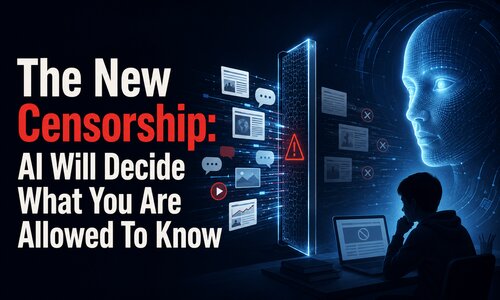
A new form of censorship is taking shape, and it may prove far more powerful than anything Americans have experienced before.
It will not arrive with banned books, government raids, or websites disappearing overnight. It will not announce itself with warning labels declaring that certain opinions have been prohibited.
Instead, it will come through a helpful chatbot.
On June 23, NewsGuard launched an artificial intelligence news service that draws its answers exclusively from 12,000 publishers the company has approved as reliable. NewsGuard says its journalists have rated more than 36,000 sources using a 100-point credibility system, and that its chatbot has been trained with 41 editorial safeguards. Partner schools and universities will be able to offer students free access while they are enrolled.
NewsGuard describes its standards as transparent and apolitical. But PragerU CEO Marissa Streit is warning that the system could bring ideological filtering directly into the classroom, teaching students that approved organizations are trustworthy while conservative sources are treated as misinformation.
The controversy is bigger than NewsGuard or PragerU. It points to a much larger question: What happens when artificial intelligence becomes the gatekeeper between the public and nearly all human knowledge?
Traditional censorship is visible. A book is removed. A speaker is silenced. A website is blocked. People can see what happened and fight back.
AI censorship can be almost invisible.
A source does not need to be banned if the chatbot never searches it. An argument does not need to be refuted if the machine never mentions it. A publication can remain online while becoming functionally invisible to millions who now rely on AI instead of search engines.
The user asks a question. The machine produces a polished, confident answer. Sources appear beneath it. Everything looks authoritative.
What the user does not see is the information excluded before the answer was written.
That is the new censorship: not erasing information, but ensuring that most people never discover it exists.
NewsGuard is already marketing its reliability data to AI companies so they can use its ratings in model training and retrieval systems–and avoid citing sources classified as unreliable. The company says its database can be integrated into AI products to shape which sources appear in responses.
This creates enormous power for whoever controls the ratings.
Who decides which mistakes make a publication unreliable? Who determines which experts are legitimate? Who defines the difference between misinformation and dissent? Who decides when a disputed scientific, political, or cultural claim has been permanently settled?
NewsGuard says trained journalists apply nine apolitical criteria. Yet those criteria still require human judgment. Analysts decide whether content is “false or egregiously misleading,” whether headlines are responsible, and whether a publication has corrected its mistakes adequately. A system can call itself neutral while still reflecting the worldview of the people operating it.
var images = [],
index = 0;
images[0] = ““;
images[1] = ““;
images[2] = ““;
images[3] = ““;
index = Math.floor(Math.random() * images.length);
document.write(images[index]);
//done