
Harvey Milk and Matthew Shepard are two of the most recognizable names in modern LGBT history.
Milk was a gay-rights activist and San Francisco politician whose 1978 assassination turned him into an enduring hero of the LGBT movement. Shepard was a 21-year-old gay man whose brutal 1998 murder in Wyoming transformed him into a national symbol for LGBT activism and hate-crime legislation.
Now look at what is happening inside the church.
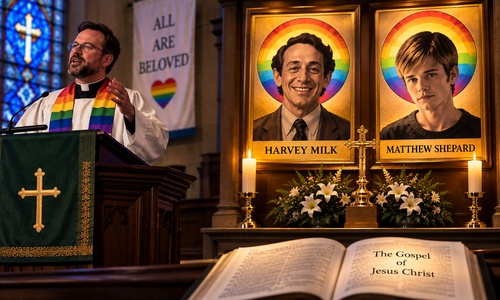
Beside a pulpit, images of Milk and Shepard sit in a small shrine-like space, their portraits surrounded by glowing halos. The symbolism is impossible to miss. These men are not simply being remembered as historical figures. They are being presented using visual language Christianity has associated with saints for centuries.
Then comes an even more remarkable claim.
The Rev. Gabriel Lawrence of The River Episcopal Church in Gates Mills, Ohio speaks of men such as these as people who “preach the good news of Jesus so much more profoundly than I ever could.”
Preach the good news of Jesus?
Harvey Milk became famous for gay political activism, not preaching Christ. Matthew Shepard became famous because he was murdered, not because he traveled the world proclaiming the Gospel.
Being an LGBT icon does not make someone a Christian saint. Being the victim of a horrific crime does not make someone a preacher of Christ. And placing a rainbow halo around someone’s head cannot transform his cultural significance into Christian holiness.
Yet that is precisely the transformation taking place before our eyes.
From LGBT Icons To Christian Saints
The Gospel has actual content.
Paul summarized it plainly in 1 Corinthians 15: Christ died for our sins, was buried and rose again. Jesus called sinners to repent and believe. The apostles preached forgiveness of sins and reconciliation with God through Jesus Christ.
Harvey Milk’s public mission was something entirely different. He fought for gay political rights, urged homosexual Americans to come out publicly and became one of the defining political figures of the gay liberation movement.
That may be activism. It may be politics. It may be culturally celebrated.
But it is not the Gospel.
Matthew Shepard’s story is different. Shepard had connections to the Episcopal Church, including having been baptized and serving as an acolyte when he was younger. But his place in American culture comes overwhelmingly from what happened to him in 1998. His murder became a rallying point for the LGBT movement and eventually helped inspire federal hate-crime legislation bearing his name.
None of that turns his death into proclamation of Christ.
This is where the theological sleight of hand becomes clear. LGBT identity becomes Christian witness. Political activism becomes evangelism. Cultural martyrdom becomes Christian martyrdom.
And suddenly the heroes of the sexual revolution are wearing halos.
var images = [],
index = 0;
images[0] = ““;
images[1] = ““;
images[2] = ““;
images[3] = ““;
index = Math.floor(Math.random() * images.length);
document.write(images[index]);
//done
Building A New Communion Of Saints
The portraits beside this particular pulpit are not an isolated curiosity.
Matthew Shepard has repeatedly been portrayed through explicitly religious imagery. He is interred at Washington National Cathedral, which displays a devotional portrait of him and connects his memory with its LGBT ministry. Elsewhere, religious artists have depicted Shepard with halos and martyr-like imagery.
Harvey Milk has received similar treatment.
Milk has appeared in Christian-style icons, including artwork by Franciscan iconographer Robert Lentz. Other depictions surround him with rainbow imagery and incorporate his assassination into LGBT adaptations of Christian devotional traditions.
Some LGBT Christian litanies have gone even further:
“Harvey Milk; Pray for us.”
“Matthew Shepard; Pray for us.”
Think about what has happened.
Two figures whose modern significance comes from the LGBT movement have crossed an extraordinary boundary. They are no longer merely political and cultural icons. Christian imagery, Christian vocabulary and Christian concepts of sainthood and martyrdom are being wrapped around them.
The sexual revolution is acquiring its own sacred history.
When Activism Becomes The Gospel
This is where Lawrence’s statement becomes so revealing.