

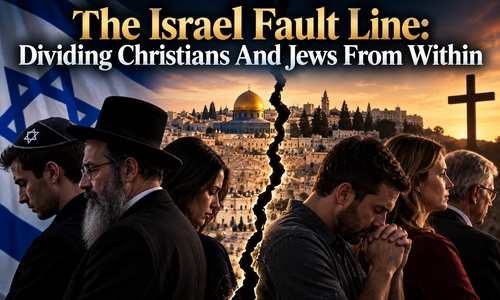
For many pro-Israel Christians, the numbers are difficult to understand.
A new national survey of Jewish voters finds that 67% plan to vote for Democratic congressional candidates in November, compared with just 26% who plan to vote Republican. At the same time, 71% say they remain emotionally attached to Israel and an overwhelming 89% say they are concerned about antisemitism in the United States.
How can those numbers exist together?
Especially when Israel has become one of the Democratic Party’s most contentious internal issues.
In July, 103 House Democrats voted for an amendment that would have cut off $3.3 billion in annual U.S. security assistance to Israel. Democratic leader Hakeem Jeffries opposed the measure, demonstrating that the party remains divided, but the vote represented a dramatic change from 2016, when the House backed the U.S.-Israel security assistance agreement 405-4.
For evangelical Christians accustomed to thinking of Israel as a defining biblical and political issue, continued Jewish support for Democrats can appear almost inexplicable.
But there is something important Christians need to understand.
There isn’t one Jewish America anymore—if there ever was.
There are increasingly two very different Jewish worlds living under the same identity.
Same Ancestry. Very Different Worldviews.
“Jewish” can describe religion, ethnicity, ancestry, culture and peoplehood. It does not automatically tell you what someone believes about God, Scripture, Israel—or politics.
That distinction becomes startling when you examine the numbers.
Pew Research found that 75% of Orthodox Jews identified with or leaned toward the Republican Party. Among American Jews overall, however, roughly seven in ten identified with or leaned Democratic.
The divide goes considerably deeper than party registration.
Ask whether God gave the land of Israel to the Jewish people and the two Jewish Americas become even clearer.
Among Orthodox Jews, 87% told Pew they believe God gave the land that is now Israel to the Jewish people.
Among Conservative Jews, that dropped to 46%.
Among Reform Jews, only about one-quarter agreed.
Among Jews who don’t affiliate with any branch of Judaism, the figure was approximately one in five.
Those aren’t simply different political opinions.
They represent fundamentally different ways of understanding Jewish identity itself.
An Orthodox Jew may see Israel through thousands of years of Scripture, covenant, exile, persecution and promised return.
A secular American Jew may care passionately about Jewish survival and antisemitism while understanding Jewishness primarily through ancestry, culture, family history, the Holocaust and shared ethnic identity.
Both call themselves Jewish.
But they may be looking at Israel through entirely different lenses.
var images = [],
index = 0;
images[0] = ““;
images[1] = ““;
images[2] = ““;
images[3] = ““;
index = Math.floor(Math.random() * images.length);
document.write(images[index]);
//done
Israel Matters—But Other Things Matter More
That helps explain the apparent contradiction in the latest polling.
The new Jewish Voters Resource Center survey found 71% emotionally attached to Israel. Yet when voters were asked to name their two highest political priorities, affordability registered 37%, the future of democracy 36%, antisemitism 25%, healthcare 18% and Israel 16%.
In other words, attachment to Israel does not necessarily translate into voting primarily on Israel.
The same poll found 75% disapproved of President Donald Trump’s performance, while 65% disapproved of the Israeli government’s policies regarding Gaza and the West Bank and 67% viewed Prime Minister Benjamin Netanyahu unfavorably.
A Jewish voter can therefore worry deeply about antisemitism, feel emotionally connected to Israel, dislike Netanyahu, oppose Israeli government policies and vote Democratic without seeing those positions as contradictory.
For many evangelical Christians, Israel may actually occupy a more explicitly theological place in their political worldview than it does for many secular American Jews.
That may sound extraordinary.
But the polling has pointed in that direction for years.
Pew found that 67% of Jews by religion expressed at least some emotional attachment to Israel, compared with just 33% of Jews of no religion. Orthodox Jews demonstrated particularly strong attachment.
October 7 Exposed What Was Already There
The Hamas massacre of October 7, 2023, and the war that followed did not create these divisions. They exposed and intensified them.
In 2024, Pew found that 85% of Jewish Republicans viewed the Israeli government favorably.
Among Jewish Democrats, it was only 41%.