
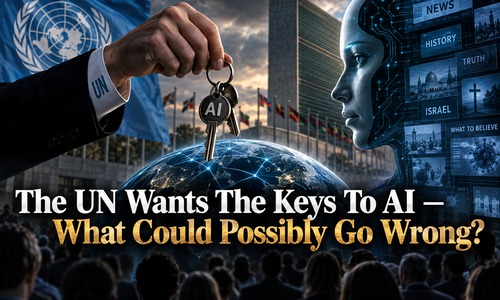
Artificial intelligence may become the most powerful information technology humanity has ever created. It will increasingly determine what people read, what children learn, how governments operate and, perhaps most importantly, what billions of people believe to be true.
So there is a question just as important as what AI will eventually be capable of doing:
Who gets to make the rules?
United Nations Secretary-General António Guterres wants the UN to play a major role in answering that question. The organization has launched a Global Dialogue on AI Governance, created an international scientific panel on AI and is pushing countries toward greater cooperation over how this technology should be controlled.
AI certainly presents enormous risks. But before giving an international institution greater influence over the rules governing the world’s most powerful technology, perhaps we should examine the institution asking for the keys.
This Is About More Than AI Safety
The UN’s Global Digital Compact explicitly calls for enhanced “international governance of artificial intelligence” and says the United Nations has “an important role to play in shaping, enabling and supporting” that governance.
The architecture is already taking shape: scientific panels, global dialogues, international cooperation and interoperable standards.
Each sounds harmless enough by itself.
Together, however, they create something much more significant — an international framework capable of influencing how governments regulate a technology that could eventually mediate much of humanity’s access to information.
And information is where this becomes especially dangerous.
Who Decides What AI Is Allowed To Tell You?
The Global Digital Compact doesn’t stop with dangerous AI systems. It also addresses “information integrity,” misinformation, disinformation and hate speech while promoting international cooperation over how these issues should be handled.
That raises an enormous question:
Who determines what constitutes misinformation?
Increasingly, people won’t search ten websites and compare competing arguments. They’ll ask an AI assistant a question and receive one synthesized answer.
What caused this war? Was this election fair? What does the Bible teach about sexuality? Is this medical treatment safe? Is this religious belief hateful? Who has the historical claim to Jerusalem?
AI won’t simply locate information. It will select, summarize, interpret and prioritize it.
Control the standards governing AI and you potentially influence the gatekeeper through which billions of people understand the world.
var images = [],
index = 0;
images[0] = ““;
images[1] = ““;
images[2] = ““;
images[3] = ““;
index = Math.floor(Math.random() * images.length);
document.write(images[index]);
//done
Israel Should Be A Warning
For Christians and supporters of Israel, the UN’s record should immediately raise concerns.
Israel has faced extraordinary scrutiny throughout the UN system. The advocacy organization UN Watch counted 15 General Assembly resolutions concerning Israel in 2025 compared with 11 concerning all other countries combined.
Then came the UNRWA scandal. A UN investigation examined allegations involving 19 employees following October 7 and ultimately concluded that evidence concerning nine indicated they “may have been involved” in the attacks. Those employees were fired.
Now imagine similar institutional judgments filtering into artificial intelligence.
Who determines how AI describes Jerusalem?
Who defines “occupation,” “terrorism,” “resistance,” “settlements” or “genocide”?
Who determines whether Israel’s biblical and historical connection to the land is legitimate history or religious mythology?
Today’s diplomatic battles could become tomorrow’s algorithmic assumptions.
And unlike a UN resolution that most Americans will never read, an AI-generated answer could reach hundreds of millions of people.
COVID Should Have Taught Us Something
The COVID era provided another lesson about concentrating authority in international institutions.
The Independent Panel for Pandemic Preparedness and Response concluded that serious failures occurred across the international system and national governments during the opening stages of COVID, famously describing February 2020 as a “lost month.”