

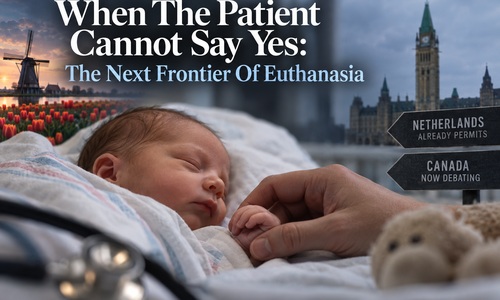
For years, euthanasia and assisted suicide have been defended around one overriding principle: choice.
A competent adult suffering from an incurable condition should be permitted, advocates argued, to decide when his or her suffering has become unbearable. Whether one agreed with that argument or not, personal autonomy was placed at the center of the debate.
But what happens when the patient never asks to die?
What happens when the patient cannot understand death, cannot request death and cannot possibly consent to it?
That question is no longer hypothetical.
In the Netherlands, physicians can intentionally terminate the life of a newborn infant under narrowly defined circumstances. Dutch government guidelines state that the baby’s suffering must be considered “unbearable” with no prospect of improvement, the diagnosis and prognosis must be certain, the parents must consent, and an independent physician must examine the child.
The Netherlands has gone further still. A separate framework allows doctors to terminate the lives of terminally ill children between the ages of 1 and 12 when they are determined to be suffering unbearably without prospect of improvement and no reasonable alternative exists to relieve that suffering. Parents participate in the decision, and the child is consulted when possible.
This is an extraordinary transformation of the original argument for assisted death.
The question is no longer simply whether someone has a “right to die.”
It is whether someone else has the right to decide that you should die.
And now that same question has surfaced in Canada.
From Canada To The Netherlands
In October 2022, Dr. Louis Roy appeared before Canada’s Special Joint Committee on Medical Assistance in Dying representing the Collège des médecins du Québec, Quebec’s professional medical regulator.
Roy told lawmakers that the organization had considered extending medical assistance in dying to babies from birth to one year old in cases involving extremely serious medical conditions and virtually no chance of survival.
The Collège subsequently clarified its position before the same parliamentary committee.
Its representative said the organization believed MAID for infants could represent “a responsible ethical solution” in cases involving an unavoidable end of life under unbearable circumstances. Its earlier report had contemplated cases involving serious malformations or syndromes with no prospect of relief or survival.
The organization emphasized that it was not proposing killing babies without parental consent and described the idea as an avenue to be explored.
The fact that one of Canada’s major medical regulators has publicly entertained this possibility should make Canadians ask where the boundaries of assisted death ultimately lie.
Because Canada has already moved those boundaries before.
var images = [],
index = 0;
images[0] = ““;
images[1] = ““;
images[2] = ““;
images[3] = ““;
index = Math.floor(Math.random() * images.length);
document.write(images[index]);
//done
Canada’s Rapidly Expanding MAID System
When Canada legalized MAID in 2016, the law required, among other things, that an eligible person’s natural death be reasonably foreseeable.
That requirement is gone.
In 2021, Parliament expanded eligibility to people whose natural death is not reasonably foreseeable, creating what is now known as “Track 2” MAID. A person therefore does not need to have a terminal condition to qualify under Canada’s current system.
The numbers have risen dramatically.
Health Canada’s latest annual report records 16,499 MAID deaths in 2024. That represented approximately 5.1 percent of all deaths in Canada—roughly one out of every 20.
And another major expansion remains scheduled.
People whose sole underlying medical condition is mental illness are currently excluded from MAID, but that exclusion is set to expire on March 17, 2027 unless Parliament changes the law again.
Terminal illness was once presented as a boundary.
Reasonably foreseeable death was a boundary.
Mental illness alone is currently a boundary.