

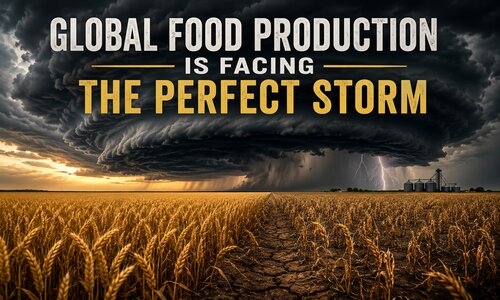
Global hunger was already soaring as we entered 2026, and now it appears that we have a historic crisis on our hands. The war with Iran has significantly restricted the flow of fertilizer out of the Middle East, and even the UN is admitting that this will make global food supplies much tighter in the months ahead. Meanwhile, the war in Eastern Europe has greatly escalated and that has resulted in severely reduced wheat exports from Ukraine.
On top of everything else, it is being projected that the strongest Super El Niño in recorded history will peak later this year, and as a result crazy weather patterns will continue to hammer crops all over the planet. At this stage, no rational person can deny what we are witnessing.
Experts are warning that this upcoming fall harvest season will be a real turning point.
Agriculture analyst Noel Fryer recently explained to CNBC why we are facing a “perfect storm” for global food production…
“A lot of things will come together to seriously affect crops next year,” Fryer said on Thursday.
“We’ve had crops decimated by weather in Europe and the U.S. A searingly hot summer in Europe has eroded grazing potential, with no hay and grass for cattle. A possible result of that is significant herd liquidation,” he said.
“We’ve got no end in sight to the Black Sea problem. The issue with fertilizer since the start of the Iran conflict is still there and if anything getting worse. U.S. corn yields look concerning after a wet spring and less fertilizer use, and could push prices up.”
We have never been through anything quite like this.
Everyone assumed that commercial traffic would always be able to flow freely through the Strait of Hormuz, but now everything has changed.
Much of the fertilizer that normally comes out of the Persian Gulf didn’t get to farmers in the northern hemisphere this year, and as a result the Food and Agriculture Organization of the United Nations is projecting that there will be a substantial tightening of global food supplies following the coming harvest season…
The Director-General of the Food and Agriculture Organization of the United Nations (FAO), QU Dongyu, emphasized today that the global fertilizer scarcity caused by disruptions in the Strait of Hormuz will lead to lower yields and tightening food supplies in the latter half of 2026 and into 2027. He spoke at the Ministerial Meeting of the MED9++ Countries on “Supporting Food Security and Access to Fertilizers” co-chaired by FAO, Italy and Croatia.
Addressing ministers and senior representatives gathered in Rome, the Director-General stressed that the current crisis extends far beyond geopolitics, increasingly affecting food production, trade, agricultural inputs and access to food worldwide.
“We meet at a moment of profound strain,” the Director-General said. “This is not only a geopolitical crisis, but also a disruption at the core of the global agrifood system.”
We really struggle to feed the planet even in the best of years.
So what will 2027 be like?
In addition to facing a global fertilizer crisis, the rapidly escalating war in Eastern Europe has severely disrupted Ukrainian grain exports…
Recent military strikes on grain export facilities, oil tankers and vessels in the Black Sea region have now made it too challenging for shipping firms to get insurance, meaning many are avoiding its ports. Alternative land routes for Ukrainian grain are also being stymied by low water levels on the Danube river, and by rail maintenance in Eastern Europe.
Ukraine is one of the great breadbaskets of the world.
That is one of the things that makes Ukraine so valuable.
var images = [],
index = 0;
images[0] = ““;
images[1] = ““;
images[2] = ““;
images[3] = ““;
index = Math.floor(Math.random() * images.length);
document.write(images[index]);
//done
But now it has become much more challenging to get grain shipped out of that nation…
Separately, Bloomberg pointed out that Russian attacks on Odesa have nearly halted Ukraine’s grain exports this peak harvest season. Total grain shipments from Ukraine have amounted to about 500,000 tons since the start of August, equivalent to roughly 20% of the country’s potential exports. The Greater Odesa ports normally handle about 90% of Ukraine’s grain shipments.
This is not a small matter.
There are some countries that are really starting to panic because it appears that the shipments that they ordered are not going to arrive on time…
Asian processors booked between 2 million and 2.5 million tons of Black Sea wheat for delivery from July through September, representing about 30% to 50% of regional import demand, according to Singapore-based traders. Traders are fretting over some grain shipments won’t arrive in time because of the widespread disruptions.
At the importer level, Egypt and Indonesia are among some of the top countries exposed to Black Sea shipments. Egypt, the world’s largest wheat importer, sourced more than 82% of its first-half imports from Russia and Ukraine. Indonesia contracted for roughly 600,000 tons from suppliers in the region for delivery in July to September.
One Singapore-based trader who sells Black Sea wheat to millers in Asia told the outlet, “The cargoes were due to start arriving from mid-August, but many ships could not go in to load. Buyers are thinking about replacing some of these cargoes with other origins, such as Australia, North America and Argentina.”
Meanwhile, the wheat harvest in the United States is going to be very disappointing this year.