

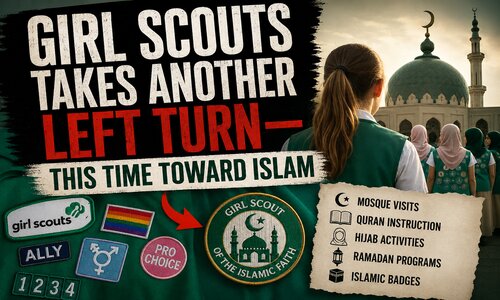
For decades, the Girl Scouts was regarded as one of America’s most wholesome institutions–a place where girls learned responsibility, service, leadership and practical skills. That image, however, is becoming increasingly difficult to reconcile with the organization many Christian parents see today.
What once focused primarily on developing young women has steadily moved toward the broader progressive culture. Controversies have included transgender ideology, concerns surrounding sexuality and abortion-related associations, and now increasingly visible Islamic religious activities conducted under the Girl Scout banner.
At some point, Christian parents have to stop asking whether every individual troop is problematic and ask a more important question: What kind of worldview is this organization helping normalize in our daughters?
The latest warning sign is Islam.
Girl Scouts of the USA officially recognizes Islamic religious awards administered through the Islamic Committee on Girl Scouting. Programs connected with Girl Scouting have included instruction about Ramadan, Islamic prayer, the Five Pillars of Islam and Hajj.
Recent reports have documented mosque-based troops incorporating Islamic practices directly into their activities. At a Girl Scout-related event at the SALAM Islamic Center in Sacramento, girls were reportedly invited to try on hijabs, learn about Islamic modesty, tour the mosque and visit an informational booth about Palestine.
Years earlier, Girl Scouts Heart of Central California highlighted troops operating from the same mosque, including a Ramadan sleepover involving fasting and girls “praying through the night.”
This goes beyond simply teaching girls that Muslims exist and should be treated respectfully. There is an important difference between learning about another religion and placing its religious observances, symbols and instruction inside an organization parents may assume is religiously neutral.
This Is Part Of A Much Larger Pattern
The concern over Islam might be easier to dismiss if it stood alone, but it follows years of controversy over the direction Girl Scouts has taken on some of America’s most divisive cultural issues.
Girl Scouts has embraced gender-identity policies that many Christian families believe directly contradict the biblical understanding of male and female. GSUSA has allowed transgender-identifying youth to participate when they are recognized and living as girls, while some local councils have gone further by explicitly embracing transgender and nonbinary identities.
Consider the contradiction: an organization created specifically for girls now operates within a cultural framework that increasingly treats biological sex as secondary to gender identity. That isn’t merely an accommodation around the edges; it raises fundamental questions about what a girls-only organization now believes a girl actually is.
Christians have also raised concerns for years about the organization’s associations, materials and broader ideological direction regarding pro-abortion indoctrination.
var images = [],
index = 0;
images[0] = ““;
images[1] = ““;
images[2] = ““;
images[3] = ““;
index = Math.floor(Math.random() * images.length);
document.write(images[index]);
//done
The Problem Is Not Muslim Children
Christians should also be clear that this isn’t an argument for mistreating Muslims or their children. Christians are commanded to love their neighbors, and Muslim families deserve dignity and respect.
But love does not require theological confusion.
Islam and Christianity aren’t simply two cultural expressions saying roughly the same thing about God. They make fundamentally different claims about Jesus Christ, Scripture, salvation and the nature of God.
Christianity teaches that Jesus Christ is the eternal Son of God, crucified for our sins and bodily raised from the dead. Islam rejects Christ’s deity and central elements of the Christian Gospel. These aren’t minor theological differences; they concern the foundation of salvation.
So when Christian parents see girls encouraged to explore Islamic practices, wear Islamic religious dress, learn the Five Pillars or observe Islamic prayer under the umbrella of an organization still associated with traditional American values, they have every right to ask what is being normalized.
Reverse the situation. Would an Islamic youth organization bring Muslim children into a church and encourage them to study the Trinity, recite Christian creeds and learn why Jesus Christ is Lord?