
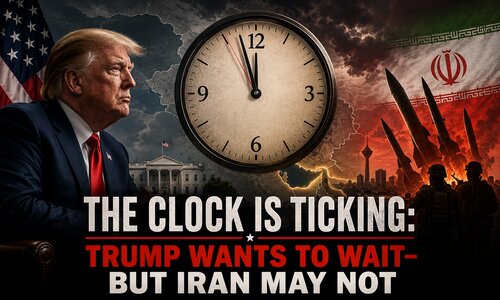
The most dangerous period in the conflict with Iran may not be determined by missiles, aircraft or troop movements. It may be determined by the calendar.
President Donald Trump appears increasingly willing to slow the military tempo and let economic pressure do the work. His administration is preparing what Treasury Secretary Scott Bessent has called the “toughest sanctions in history,” targeting Iran’s oil revenues, financial networks and countries that continue doing business with Tehran. Trump himself recently described the approach as “low-keying it,” signaling that, at least for now, he prefers economic warfare to another major round of strikes.
That strategy requires something Washington believes it has: time.
Iran may be reaching exactly the opposite conclusion.
If Tehran believes the sanctions campaign will steadily weaken its economy, limit its ability to rebuild damaged military capabilities and increase internal pressure, then waiting until winter could leave it with fewer options than it has today.
And hanging over both calculations are two dates: Israel holds its national election on October 27. The United States holds its midterm elections exactly one week later, on November 3.
That creates a potentially explosive window in which Washington has powerful reasons to avoid escalation–and Tehran may have powerful reasons to provoke it.
Trump’s Strategy: Let Time Work Against Iran
From Washington’s perspective, another large-scale military offensive carries substantial risks.
It could produce American casualties. It could trigger larger Iranian retaliation. It could further disrupt the Strait of Hormuz and send oil and gasoline prices higher at precisely the moment voters are deciding control of Congress.
Economic pressure offers Trump another option.
The administration believes months of warfare have left Iran substantially weakened and that sanctions may now accomplish what earlier financial pressure could not. The United States can squeeze Iranian petroleum exports, banking relationships and international trade while maintaining military pressure in the background.
The strategy is essentially: Why risk another costly military campaign today if Iran might be significantly weaker several months from now?
There is also an obvious political advantage to patience.
Even if the White House never publicly says it wants to avoid major escalation before November 3, presidents understand that wars are politically unpredictable. A successful operation can strengthen public confidence. A failed raid, captured American soldiers, rising gasoline prices or an unexpected regional escalation can dominate an election overnight.
Trump therefore has every reason to keep his options open while avoiding unnecessary surprises.
Iran, however, understands the same calendar.
Tehran’s Problem: Waiting May Only Make Things Worse
Iran must ask a very different question:
What will its position look like after November 3?
If American sanctions become increasingly effective, Iranian oil revenues decline, military equipment becomes harder to replace and Trump emerges from the midterms with fewer immediate political constraints, Tehran could find itself negotiating from an even weaker position.
That creates an uncomfortable strategic possibility.
Iran’s best opportunity to create leverage may be before the elections rather than after them.
Mark Dubowitz, CEO of the Foundation for Defense of Democracies, has warned specifically about the possibility of an Iranian “October surprise”–an operation deliberately timed around the Israeli and American elections. His argument is not that anyone knows precisely what Iran will do, but that Tehran has an unusually strong incentive to exploit this narrow political window.
Recent Iranian rhetoric makes the possibility harder to dismiss.
Iranian Army commander Amir Hatami announced a $30,000 reward for killing or capturing an American service member, reportedly doubling the reward if carried out by a woman. Iranian propaganda has simultaneously featured increasingly graphic threats against American political and military targets.
The question is whether those threats are merely psychological warfare–or preparation for something more.
var images = [],
index = 0;
images[0] = ““;
images[1] = ““;
images[2] = ““;
images[3] = ““;
index = Math.floor(Math.random() * images.length);
document.write(images[index]);
//done
Iran Doesn’t Need To Defeat America
This is where Tehran’s potential strategy becomes especially dangerous.
Iran cannot defeat the United States conventionally. But it does not have to.
It only needs to create a crisis Washington cannot easily ignore.
Imagine several possible scenarios.
A significant number of American troops are killed at a regional base.
American service members are captured.
An Iranian proxy conducts a major attack that Washington attributes to Tehran.
Israel suffers a missile attack severe enough that retaliation becomes unavoidable.
Shipping through the Strait of Hormuz is disrupted again, sending oil prices sharply higher.
None of those events would defeat the United States militarily.