
Something unusual is happening in American politics.
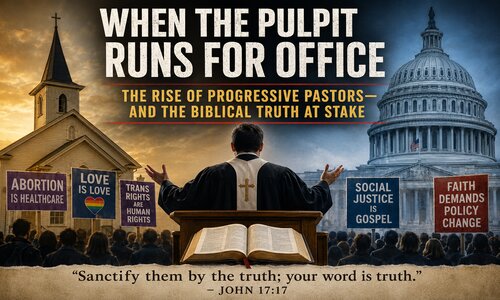
Pastors, ministers and seminarians associated with progressive Christianity are increasingly running for political office — and they are not hiding their religious identities. Quite the opposite. Many are explicitly presenting their progressive political agendas as expressions of their Christian faith.
One of the most prominent examples is Rev. Adam Hamilton, founding pastor of Resurrection Church in Kansas and now the Democratic nominee for the U.S. Senate.
Hamilton portrays himself as an independent-minded moderate who wants to bridge America’s political divisions. He has described his congregation as roughly divided between Republicans, Democrats and independents and says his experience leading such a diverse church qualifies him to bring people together politically.
But conservative Christians examining Hamilton’s theology will find disagreements that reach considerably deeper than party politics.
They concern a fundamental question:
When Scripture conflicts with modern cultural values, which one gets the final word?
When Christians Sit In Judgment Over Scripture
Hamilton has long argued that some biblical statements attributed to God may actually reflect the cultural limitations and understandings of their human authors.
He has pointed particularly to difficult Old Testament passages involving warfare and judgment. Hamilton has argued that certain portrayals of God appear inconsistent with the character of God revealed through Jesus.
That same interpretive approach subsequently influenced his thinking about homosexuality.
Hamilton has publicly discussed asking how much latitude Christians have to “push back” against Scripture — even asking whether there are places where Christians might conclude that the Apostle Paul was wrong. He connected that question directly to reconsidering biblical passages traditionally applied to same-sex relationships.
This represents a profound departure from the conservative evangelical understanding of biblical authority.
Traditional Christianity does not teach that every command given to ancient Israel applies directly to Christians today. Scripture contains different covenants, literary genres and historical contexts that must be interpreted carefully.
But that is dramatically different from concluding that Scripture itself incorrectly represents God’s will.
Paul writes in 2 Timothy 3:16 that “all Scripture is God-breathed.”
Peter says men “spoke from God as they were carried along by the Holy Spirit” (2 Peter 1:21).
Jesus repeatedly answered theological controversy with the words, “It is written.”
Once Christians begin deciding which portions of Scripture accurately represent God and which ones do not, an unavoidable question emerges:
Who becomes the final authority — Scripture or the person interpreting it?
var images = [],
index = 0;
images[0] = ““;
images[1] = ““;
images[2] = ““;
images[3] = ““;
index = Math.floor(Math.random() * images.length);
document.write(images[index]);
//done
Same-Sex Marriage Shows Where This Leads
Hamilton’s evolving position on sexuality demonstrates the real-world consequences of that interpretive method.
He has argued that biblical condemnations of same-sex sexual behavior may not address modern homosexual relationships characterized by mutual love and commitment.
He eventually became an advocate for changing United Methodist policy concerning homosexuality and supported the denomination’s 2024 removal of restrictions involving same-sex marriage and gay clergy.
For conservative Christians, the objection is not that homosexual people should be mistreated. Every human being bears God’s image and deserves dignity, kindness and compassion.
The theological disagreement concerns whether compassion gives Christians authority to redefine what Scripture identifies as marriage.
When Jesus discusses marriage in Matthew 19, He reaches back to Genesis:
“Male and female He created them.”
“For this reason a man shall leave his father and mother and be joined to his wife.”
Traditional Christian teaching therefore understands marriage not as a cultural invention that Christianity subsequently adopted, but as an institution rooted in creation itself.
Abortion Reveals Another Major Divide
Hamilton’s 2026 campaign has now formally identified him as pro-choice on abortion.
He has expressed personal discomfort with abortion while opposing government restrictions that would broadly prohibit it.
Again, conservative Christians see something deeper than partisan politics.
Psalm 139 describes God forming human beings within the womb.
Jeremiah 1:5 declares, “Before I formed you in the womb I knew you.”
Luke 1 describes the unborn John the Baptist responding to the presence of the unborn Christ.
Christians can disagree about public policy, penalties and genuinely difficult medical circumstances. But the conviction that unborn human life possesses profound moral value is not something American conservatives invented in the twenty-first century.
It is rooted in a much older Christian understanding of the sanctity of human life.
Hamilton Is Not Alone
Hamilton’s candidacy would be less noteworthy if he were an isolated case.
Religion News Service reported in August that at least 12 pastors, seminarians or former clergy ran for federal office as Democrats during the 2026 cycle, with seven becoming Democratic nominees.
Republicans have clergy candidates as well. RNS counted seven current or former evangelical pastors who launched Republican congressional campaigns this cycle, although only three ultimately became nominees.
So clergy entering politics is certainly not exclusively a phenomenon of the political left.
What is particularly noteworthy about the progressive candidates, however, is how frequently debates over biblical authority, abortion, sexuality and gender accompany their political theology.
Consider some examples.
Rev. Sarah Trone Garriott
Rev. Sarah Trone Garriott is an ordained ELCA Lutheran minister, Iowa state senator and Democratic congressional nominee.
Her political record includes positions that place her sharply at odds with conservative Christian social teaching.
Garriott has supported abortion rights and opposed multiple Iowa measures dealing with transgender policy. Her legislative record includes opposition to restrictions on gender-transition procedures for minors, legislation requiring school bathrooms to correspond with biological sex and restrictions preventing biological males from participating in girls’ sports.
RNS reports that Garriott remains a pastor in good standing in the ELCA and says her ministry and experience as a hospital chaplain inform her work in government.
For conservative Christians, however, the issue is precisely the theological tension between that ministerial identity and policies involving unborn life, biological sex and gender.
Rev. Lindsay James, an ordained Presbyterian Church (USA) minister and Iowa legislator, provides another clear example.
James has called for restoring Roe v. Wade protections and supports abortion rights. Her record also includes support for LGBTQ protections and opposition to legislation requiring parental consent before schools recognize certain changes involving a child’s gender identity.
She defeated another pastor, United Methodist minister Clint Twedt-Ball, in the Democratic primary and is now the Democratic nominee for Iowa’s 2nd Congressional District. RNS specifically notes that both James and Garriott have faced criticism from conservative Christians over their support for LGBTQ and transgender policies.
For Christians who understand unborn life as sacred, biological sex as part of God’s created order and parents as possessing primary responsibility for their children, these are not minor differences over tax policy.
They concern basic questions of Christian anthropology and morality.
Rev. Clint Twedt-Ball
Rev. Clint Twedt-Ball, the United Methodist pastor defeated by James in the June primary, represents another part of the trend even though he will not appear on the November ballot.
Twedt-Ball explicitly described political involvement as an extension of his faith and spoke of bringing theology into the public square.
During the campaign, he opposed federal restrictions on certain gender-related medical treatment for minors when parents approve and argued that, while parents should generally be involved when children adopt different gender identities, other trusted adults or community members might sometimes play a role.