
Something strange is happening in America’s spiritual landscape.
Witchcraft, tarot, paganism and occult spirituality have moved out of the shadows and into the mainstream. Social media is filled with tarot readings. Online marketplaces sell spells and curses. Hollywood increasingly presents witches as sympathetic, empowered spiritual seekers, while younger Americans experiment with practices their grandparents would have immediately recognized as occult.
But at the same time, something remarkable is happening in the opposite direction.
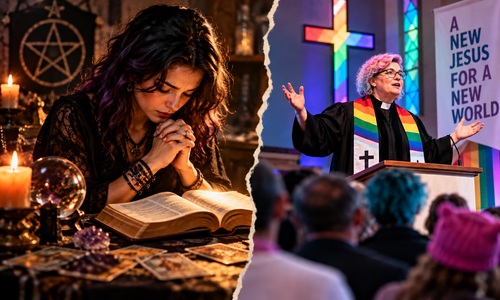
Some people immersed in tarot, New Age spirituality and occult practices are discovering Jesus Christ—and concluding that following Him means leaving those things behind.
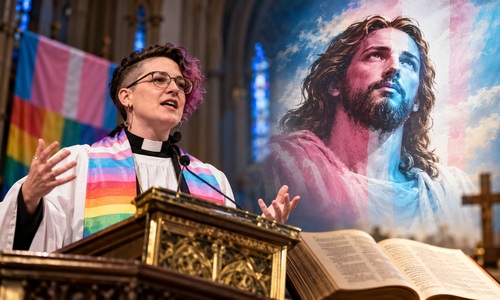
Meanwhile, inside some of America’s most progressive churches, the movement appears to be going the other way. Instead of allowing Christianity to challenge the culture, biblical language is being reconsidered, historic sexual ethics discarded and even traditional understandings of God and Jesus reimagined.
The irony is difficult to miss.
Some people outside the church are discovering that Jesus requires them to change.
Some people inside the church seem determined to change Jesus.
When A Tarot Reader Meets Jesus
Alexandra Ashcroft built an enormous audience as “Alex Reads Tarot.”
Nearly one million people followed her online, where tarot wasn’t merely a private curiosity. It was her platform, identity and business.
Then something changed.
In June, Ashcroft wiped away her tarot content and announced that she had become a Christian.
“Jesus Christ has saved my life, and I can no longer ignore that reality,” she told her followers.
She explained that the transformation hadn’t happened overnight. For nearly a year she had been questioning, praying and wrestling with what she believed. Eventually, Christianity became incompatible with the spiritual practices that had made her famous.
Her old account had accumulated tens of millions of likes. Yet she abandoned the very content that had built her following.
Then consider Kat Von D.
The famous tattoo artist had long cultivated a dark, macabre aesthetic and possessed books dealing with witchcraft, the occult and tarot. In 2022 she publicly announced that she was getting rid of them.
“I got a lot of things wrong in my past,” she wrote.
Von D later described some of the alternative spiritual practices she had pursued as empty attempts to fix something deeper. Eventually she began attending church, embraced Christianity and publicly underwent Christian baptism.
These stories contain an extraordinary irony.
People immersed in occult and alternative spirituality can reach a moment when they recognize that following Jesus means surrendering things that are incompatible with Him.
But what happens when churches stop asking anyone to surrender anything?
var images = [],
index = 0;
images[0] = ““;
images[1] = ““;
images[2] = ““;
images[3] = ““;
index = Math.floor(Math.random() * images.length);
document.write(images[index]);
//done
When Christianity Stops Correcting The Culture
Consider what is happening within the Presbyterian Church (U.S.A.).
Developments inside America’s largest mainline Presbyterian body illustrate something much bigger happening throughout progressive Christianity.
Rev. Jim Rigby has pastored St. Andrew’s Presbyterian Church in Austin, Texas, for decades.
Recent undercover footage showed Rigby explaining that the congregation typically gives new members The Inclusive Bible, a translation deliberately constructed to reduce gendered language. Rigby praised it for being “good on the gender stuff.” Reporting on the translation notes that it alters traditional formulations involving titles such as “Son of God.”
Rigby’s theology goes considerably further.
The Texas Tribune reported this year that he avoids traditional Christian prayers and creeds in services because he doesn’t want non-Christians to feel excluded. It reported that he sees Jesus as closer to a “loving atheist than an indifferent theologian.”
Think about the contrast.
A tarot reader encounters Christianity and concludes that she must abandon tarot.
Meanwhile, inside a Christian church, elements of traditional Christianity become the things that must be abandoned.
And Rigby isn’t simply an isolated minister operating completely outside his denomination’s trajectory.
PC(USA)’s own website enthusiastically profiled Rev. Bethany Peerbolte and her online “Progressive Christian message.” Peerbolte became widely noticed after appearing with a transgender stole. She explained that she began creating content after finding online Christianity too focused on the afterlife rather than social justice.
The denomination now officially celebrates “all gender identities and sexual orientations,” and its constitution was amended to specifically include sexual orientation and gender identity among categories protected in church participation.
This summer, its General Assembly went further, approving a mechanism allowing congregations to identify themselves as ready to call LGBTQIA+ pastors. During the debate, one trans nonbinary Presbyterian pastor argued against the proposal—not because LGBTQ theology had gone too far, but because queer pastors should be able to enter congregations that haven’t yet had those conversations and “help people grow.”