
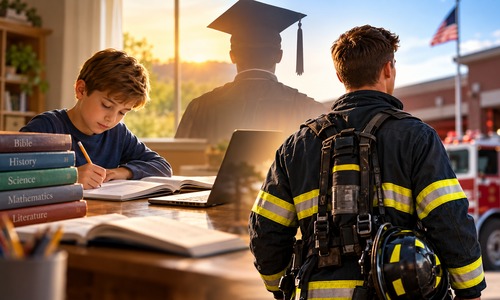
For 22-year-old Andrew Coates, becoming a professional firefighter seemed like a natural next step.
He already volunteers with the Cedar Bluffs Fire Department in Nebraska. He holds a state EMT license. He has experience responding to emergencies and wants to make a career out of doing what he already loves.
But when Coates applied to become a paid firefighter in Fremont, Nebraska, he ran into an obstacle that had nothing to do with fighting fires.
He had been homeschooled.
The city’s original job posting required “graduation from high school.” But Fremont rejected Coates because his homeschool diploma did not come from an accredited high school. The city subsequently changed its wording to specifically require graduation from an accredited school.
Coates challenged the decision, arguing that the issue was now bigger than his application. “We want to make sure that every homeschooler has an equal opportunity,” he told WOWT.
His case should get America’s attention because Coates isn’t an educational anomaly anymore.
He’s part of a generation that is rapidly getting bigger.
The Homeschool Boom Didn’t End With COVID
When schools shut down during the pandemic, homeschooling exploded. Many assumed families would eventually return to the old system and homeschooling numbers would settle back to their previous levels.
That hasn’t happened.
New data from the Johns Hopkins Homeschool Research Lab show that of the 22 states reporting 2025-26 numbers so far, 17 — 77 percent — experienced another increase in homeschooling.
Montana jumped 27.7 percent. North Dakota increased 18.8 percent. Arkansas rose 14 percent. Nebraska increased 9.8 percent, California 8.5 percent and Vermont 8.4 percent.
Arkansas, Nebraska, North Dakota, South Carolina, South Dakota and Wisconsin have now reached their highest recorded homeschool enrollment.
Homeschooling hasn’t disappeared with the pandemic. It has become an established part of the American educational landscape.
And what people call “homeschooling” increasingly doesn’t resemble the stereotype.
A nationally representative Johns Hopkins/RAND survey found 88 percent of homeschooling parents use additional educational resources. Forty-four percent use online resources, 29 percent participate in co-ops, 27 percent use online classes and 24 percent use online schools.
Today’s homeschool can be part kitchen table, part online academy, part co-op, part tutor and part community classroom.
Something bigger than homeschooling is happening.
Parents are discovering that education doesn’t necessarily have to come from one building, one curriculum or one institution.
var images = [],
index = 0;
images[0] = ““;
images[1] = ““;
images[2] = ““;
images[3] = ““;
index = Math.floor(Math.random() * images.length);
document.write(images[index]);
//done
Why This Matters Even If Your Kids Attend Public School
It would be easy for parents with children in public or private schools to look at these battles and conclude they don’t concern them.
Behind the homeschooling debate is a much larger question: Who bears primary responsibility for a child’s education?
Government unquestionably has legitimate interests in protecting children and ensuring they receive an education. The disagreement begins when “ensuring an education” becomes defining exactly what that education must look like.
Consider how differently states already answer that question.
Rhode Island requires homeschool instruction to cover subjects including reading, writing, geography, arithmetic, U.S. and Rhode Island history and American government. Attendance must be substantially equivalent to public schools, and local school committees approve home instruction.
New Hampshire just moved dramatically in the opposite direction. A law taking effect this year makes homeschool declarations largely optional, eliminates annual evaluations and makes certain record keeping optional. Its law explicitly recognizes a parent’s right to direct a child’s education as a “natural right.”
Those are two very different philosophies of the relationship between family and state.
And that question reaches far beyond homeschoolers.
It touches Christian schools, private education, charter schools, curriculum disputes, religious instruction and ultimately the ability of parents to make educational choices that differ from whatever government considers normal.