

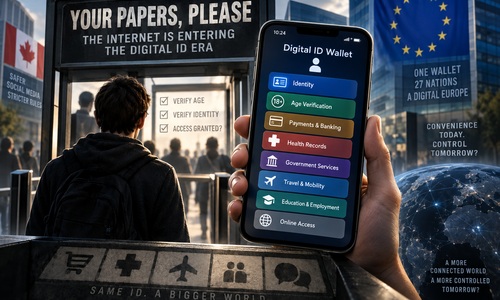
For most of the internet’s history, opening a website required little more than an internet connection. You could read, search, post, debate and browse without first proving to a government-backed system who you were.
That era may be beginning to close.
Governments increasingly want online platforms to know something about the person sitting behind the screen — beginning with age. Canada is moving toward tougher age requirements for social media, while Europe is developing age-verification technology that can be incorporated directly into its new continent-wide Digital Identity Wallet.
The justification is easy to understand: protect children from pornography, predatory behavior, addictive social media and harmful content.
But once the infrastructure exists to prove something about you before allowing you through a digital doorway, an enormous question follows.
What else might eventually require that digital credential?
First, Prove Your Age
Canada’s proposed Safe Social Media Act would establish a new Digital Safety Commission and give it authority to develop rules concerning age estimation and age verification. The government says it intends to establish a minimum age of 16 for social-media accounts, subject to possible exemptions for platforms with sufficient safeguards.
Europe is moving even further technologically.
The European Commission has developed an age-verification system that allows someone to prove that he or she meets an age threshold without necessarily revealing identity or other personal information. The Commission emphasizes that the technology has been designed around privacy.
But there is another important detail.
The EU calls it a “mini wallet.” It uses the same technical specifications as the European Digital Identity Wallets being rolled out across all 27 EU member states and was deliberately designed so age verification can eventually be integrated into those wallets.
In other words, Europe isn’t merely building an online age gate.
It is building an identity ecosystem.
This Isn’t Just An ID Card
The phrase “digital ID” can create the misleading impression that governments are simply putting your driver’s license on your phone.
The European Commission’s own vision is much broader.
The EU Digital Identity Wallet is designed to allow people to identify themselves to public and private services, store official credentials, electronically sign documents and prove specific attributes about themselves.
Its proposed uses include government services, driver’s licenses, employment and educational credentials, travel documents, SIM registration and social-security information.
Then come two particularly important categories: health and money.
EU documentation describes using the wallet for medical prescriptions and health-related credentials. Its ePrescription system envisions citizens storing a Health ID attestation in their wallet and presenting the wallet at a pharmacy to retrieve prescriptions.
The wallet can also be used to open bank accounts and authenticate payments. EU technical documentation describes payment authentication for both online and in-store purchases.
Consider what is converging inside one technological framework:
Government services.
Employment qualifications.
And potentially access to major online platforms.
The EU presents this primarily as convenience, security and user control. And there are obvious conveniences. One credential could eliminate countless passwords, forms, photocopies, identity checks and repeated submissions of personal information.
But convenience and control are not opposites.
A system can provide enormous convenience while simultaneously creating an infrastructure capable of exercising enormous control if its rules, architecture or political environment change.
var images = [],
index = 0;
images[0] = ““;
images[1] = ““;
images[2] = ““;
images[3] = ““;
index = Math.floor(Math.random() * images.length);
document.write(images[index]);
//done