

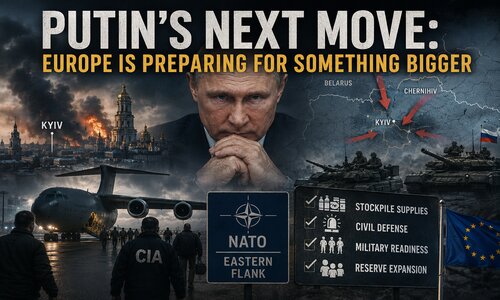
Something has changed in the atmosphere surrounding the war in Ukraine.
For more than four years, Western governments have worried about escalation with Russia while operating under one critical assumption: the war could be contained. Ukraine would fight, Europe and America would supply weapons, Russia would threaten retaliation, and NATO would reinforce its eastern frontier.
But the fighting itself would remain largely inside Ukraine.
Recent developments are raising uncomfortable questions about how much longer that assumption will hold.
Ukrainian officials now say Russian military leaders have been ordered to prepare several possible operational scenarios for a new offensive in northern Ukraine, including the Kyiv and Chernihiv regions. That does not mean such an offensive is imminent, nor does it mean Russia has assembled the enormous force necessary to capture Kyiv.
But Kyiv appearing again in Russian military planning should get everyone’s attention.
The Ukrainian capital was the great prize Vladimir Putin failed to take in 2022.
What happens if Russia decides to threaten it again?
And perhaps more importantly, what happens if this time Ukraine begins to buckle?
The answer could extend far beyond Ukraine.
Putin Needs A Way To Change The War
Russia has spent years grinding forward at enormous cost, capturing territory village by village while Ukraine increasingly strikes military, energy and infrastructure targets deep inside Russia.
But if Putin ultimately wants to bring this war to an end on Russian terms, capturing another handful of towns in eastern Ukraine may not produce the political shock necessary to force Kyiv into submission.
Threatening the capital would be different.
Even without capturing Kyiv, opening another northern front could force Ukraine to redistribute troops, stretch already limited air defenses and create enormous psychological pressure on the government.
It could also create exactly the kind of crisis Europe has spent the last two years quietly preparing for.
Europe Is Preparing Its Population
Look across Europe and a remarkable pattern has emerged.
Sweden has distributed updated “In Case of Crisis or War” preparedness information to millions of households. Finland has issued guidance covering everything from long power outages to military conflict. Poland has prepared civilian emergency guidance.
Then the European Union itself urged citizens to be capable of surviving independently for at least 72 hours during a major crisis, recommending supplies including food, water, medicine, radios, flashlights and cash.
This is no longer the language of survivalists preparing for some distant catastrophe.
It is government policy.
Military preparations have been even more significant.
Germany has developed Operational Plan Germany, a whole-of-society defense concept for transforming the country into a critical logistical hub if NATO must move enormous numbers of troops and equipment eastward.
Poland has pushed large-scale military training and reserve expansion. NATO has reinforced its eastern flank, established additional multinational forces and developed its most comprehensive defense plans since the Cold War.
Across Europe, subjects that would have seemed politically extraordinary only a few years ago have returned to mainstream debate: conscription, expanded reserves, hardened borders, ammunition stockpiles, civil defense, military mobility and preparing civilian infrastructure for wartime use.
Europe isn’t doing this because its leaders know a war with Russia is coming.
They are doing it because they no longer believe they can safely assume one isn’t.
var images = [],
index = 0;
images[0] = ““;
images[1] = ““;
images[2] = ““;
images[3] = ““;
index = Math.floor(Math.random() * images.length);
document.write(images[index]);
//done
What Happens If Kyiv Is Threatened?
This is where the situation becomes dangerous.
Imagine that Russia eventually launches a major northern offensive.
Ukrainian defenses struggle.
Russian forces begin moving toward Kyiv.
President Volodymyr Zelensky appeals to European governments for emergency assistance.
Britain and France have already gone much further than many would have imagined when the war began. European governments have progressively crossed one threshold after another regarding weapons supplied to Ukraine.
Now Britain and France are sharing sensitive technology enabling Ukraine to manufacture Storm Shadow/SCALP long-range cruise missiles. Moscow responded with an unusually forceful warning, saying British military installations and equipment inside Ukraine and beyond its borders could become targets in retaliation for Ukrainian strikes using British weapons.
Russia accused Britain and France of “playing with fire.”
Now imagine that warning colliding with a genuine battle for Kyiv.
Would Poland simply watch Ukraine’s capital fall?
Would European governments that have spent billions of dollars preparing Ukraine to survive conclude that they must finally intervene more directly rather than accept Russian victory?
But that is precisely where the dominoes begin lining up.
How The Dominoes Could Fall
A Russian offensive creates the threat of Ukrainian collapse.
The threat of collapse produces greater European intervention.