

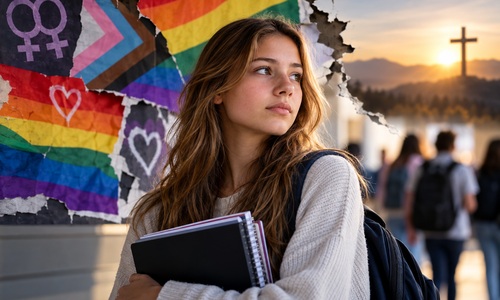
For years, Americans were told that the dramatic rise in LGBT identification among young people represented an unstoppable cultural transformation. Each new generation would be more sexually fluid, more willing to reject traditional labels, and more likely to embrace identities that previous generations had rarely discussed.
But something unexpected is happening among America’s youngest teenagers. The numbers are moving in the opposite direction — and the decline is dramatic.
According to an analysis of federal survey data by San Diego State University psychology professor Jean Twenge, the percentage of ninth-grade girls identifying as lesbian or bisexual fell from 30% in 2021 to just 17% in 2025. Even more striking, the percentage identifying specifically as bisexual dropped from 26% to 13% — a 50% decline in only four years.
Across all ninth-graders, lesbian, gay, or bisexual identification reportedly fell from 17% in 2023 to 11% in 2025. Older teenagers showed much smaller changes, suggesting that whatever is happening may be particularly significant among the youngest members of Generation Z and those following behind them.
Twenge described the decline as looking like a “free fall,” while acknowledging that its causes remain unclear.
That uncertainty deserves attention. But so does a question that few people were asking when the numbers were rapidly climbing: What if part of America’s teenage sexual identity explosion was shaped by cultural influences that are now beginning to change?
When Sexual Identity Became A Cultural Obsession
It is difficult to overstate how dramatically American culture changed its messaging toward children over the past decade.
Television programs, streaming services, celebrities, social media influencers, corporate advertising, and educational institutions increasingly placed sexual identity at the center of conversations about personal authenticity.
Young people were encouraged to explore their identities, question traditional assumptions, and view sexuality as an essential component of discovering who they really were.
For many teenagers, particularly girls navigating the already confusing years of adolescence, the message was nearly impossible to escape.
The internet introduced an expanding vocabulary of sexual identities, while social media communities offered affirmation, belonging, and recognition around those labels. In some online environments, discovering a new identity became a major personal milestone, complete with public announcements and enthusiastic support.
Adolescence is a period when peer acceptance, social expectations, and the language available to describe personal experiences can exert enormous influence.
It is therefore reasonable to ask whether the extraordinary rise in bisexual identification reflected changing cultural expectations about how teenagers understood and described themselves.
And if those expectations are changing again, perhaps the survey numbers are beginning to reflect it.
Is The Rainbow Culture Losing Its Influence?
Consider the timing.
The dramatic increase in LGBT identification coincided with an era in which sexual identity became one of the most celebrated and politically charged subjects in American public life.
Pride celebrations expanded. Corporations adopted rainbow branding. Schools became battlegrounds over sexual identity and gender ideology. Entertainment companies increasingly made LGBT representation a central part of their programming.
At the same time, social media amplified conversations about sexuality to an unprecedented degree.
But cultural movements can experience fatigue, particularly when something once presented as countercultural becomes an established expectation.
Could some younger teenagers be growing tired of the constant emphasis on labels? Are they less interested in turning every uncertainty about attraction or relationships into a declaration of identity? Has the cultural pressure surrounding these subjects begun to weaken?
The CDC survey cannot tell us whether the decline reflects changing attitudes, social pressures, patterns of disclosure, or some combination of factors. And today’s teenagers still remain more likely to identify as lesbian, gay, or bisexual than teenagers did before the pandemic.
Nevertheless, the reversal challenges the assumption that the previous trajectory could only continue upward.
For years, rising identification was frequently interpreted as evidence of permanent social change. Now that the numbers are falling among younger teenagers, those same cultural assumptions deserve closer examination.