
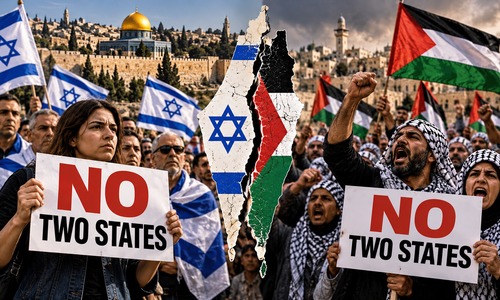
The diplomats in New York, London, and Paris are still selling a Palestinian state, but the people who would have to live with one have stopped buying. A new Gallup survey released Tuesday, on the eve of the third anniversary of the October 7 massacre, found that 65% of Israelis oppose the establishment of an independent Palestinian state alongside Israel, with only 26% in favor. Among Arabs in Judea and Samaria and eastern Jerusalem, the very people in whose name the state is demanded, 58% oppose it and only 32% support it.
The two-state solution, stripped of its diplomatic packaging, means the creation of an unprecedented Palestinian state inside Israel’s borders, militarized and ethnically cleansed of Jews, with its exclusively Muslim capital in Jerusalem, centered on Judaism’s holiest site, the Temple Mount. It was the engine of the Oslo land-for-peace process of the 1990s, which instead of peace produced three intifadas, countless terrorist attacks, years of rocket fire from Gaza and the current war against Hamas.
The numbers mark a collapse. In 2012, 61% of Israelis and 66% of Palestinians backed the two-state formula. Since then, support has fallen by 35 percentage points among Israelis and roughly 34 points among Palestinians. “Both figures remain about half of what they were when Gallup asked this question in 2012,” wrote Gallup’s Benedict Vigers.
The collapse came before the war. In 2023, just before the Hamas invasion, Gallup found support at 25% among Israelis and 26% among Palestinians. Three years of fighting have barely moved those figures. Israeli support is virtually unchanged, while Palestinian support has risen modestly. The Palestinian figures exclude Gaza, where Gallup has been unable to survey since the war began. The future looks worse. In Gallup’s 2023 survey, taken just before the massacre, only one in six Palestinians aged 15 to 25 supported a state alongside Israel, half the rate of Palestinians over 46.
Gallup interviewers spoke face-to-face with 1,000 adults in Israel between May 31 and July 10 of this year, and with 1,000 Arab adults in Judea and Samaria and eastern Jerusalem between May 13 and June 11. The Jewish communities of Judea and Samaria were left out of the Palestinian sample, and Israeli communities evacuated along the Lebanese border were left out of the Israeli one. The margin of error is about 3.5 points on each side.
A divided Israel, a united rejection
The sharpest divide in the survey runs through Israeli politics. Among Israelis who approve of the current government, 5% support a Palestinian state and 91% oppose it. Among Israelis who disapprove of the government, support rises to 43%, a 38-point gap. Even in the camp most opposed to the government, a Palestinian state falls short of half.
Among Palestinians, the answer barely changes with politics. Supporters and opponents of the Palestinian leadership differed by only seven points, and the gap runs the opposite way. Palestinians who approve of their leadership back a state at 37%, while those who disapprove back it at 30%. Rejection of a state alongside Israel is strongest among the Palestinians who reject their own leaders.
The survey also measured hope for peace, and found little on either side. Just 22% of Israelis and 21% of Palestinians believe permanent peace will ever be achieved. Israeli hope peaked at 34% in 2017 and crashed to 13% in the weeks after October 7. Israelis who support two states are optimists: 73% of them believe lasting peace will come. Palestinians who support a state are the opposite. Only 36% of them believe a state would bring lasting peace, while 59% expect the conflict to continue.
var images = [],
index = 0;
images[0] = ““;
images[1] = ““;
images[2] = ““;
images[3] = ““;
index = Math.floor(Math.random() * images.length);
document.write(images[index]);
//done
That last figure exposes what the diplomats refuse to hear. For most Palestinians who say they want a state, the state is a stage in the conflict and the conflict goes on.
“Views on fundamental questions of peace and Palestinian statehood remain stable and pessimistic on both sides of the conflict,” Gallup concluded.
“In Israel, the idea of an independent Palestinian state is deeply politicized, splitting clearly according to views on current leadership,” Gallup added. “Among Palestinians, views are less divided along political lines.”
A Pew Research Center survey published in September reached the same conclusion. Only 17% of Israelis and 21% of Palestinians in Judea and Samaria and eastern Jerusalem told Pew that Israel and a Palestinian state could coexist peacefully, while 56% of Israelis and 68% of Palestinians said they could not. Israeli respondents pointed to the security danger a Palestinian state would pose. Two women summed up the two sides in a single sentence each.
“This is our land alone,” a Jewish Israeli woman told Pew researchers.