
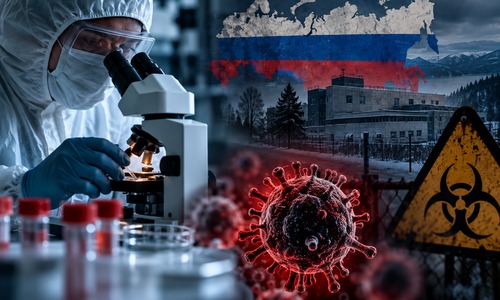
Something strange happened at a Russian laboratory that studies some of the most dangerous pathogens on Earth.
Twenty-eight-year-old Darya Shipilova, an employee of the Irkutsk Anti-Plague Research Institute in Siberia, became seriously ill and died October 2 from what Russian authorities describe as pneumonia of unknown origin. Reports circulated that she may have been exposed to pneumonic plague in a laboratory accident, although Russian officials deny that account and say testing found no pathogen connected to her work.
Nearly 200 contacts were initially placed under medical observation or isolation. Most have since been released, Russia says no plague has been detected, and the World Health Organization currently considers the broader public-health risk very low.
Perhaps that will ultimately be the end of the story.
But the incident has opened the door to a much larger question that received far less attention during the COVID pandemic and deserves considerably more today:
What exactly are laboratories around the world doing with the deadliest pathogens known to mankind?
The Diseases We Don’t Talk About
COVID was devastating, but biologically speaking, it was nowhere near the worst pandemic scenario imaginable.
The World Health Organization maintains a list of pathogens considered priorities because of their epidemic potential and the limited countermeasures available against them. It includes Ebola and Marburg, Nipah virus, Lassa fever, MERS and SARS, Crimean-Congo hemorrhagic fever and something ominously called “Disease X” — WHO’s placeholder for a currently unknown pathogen capable of causing a serious international epidemic.
Consider Nipah virus. Some outbreaks have produced extraordinarily high fatality rates. Fortunately, Nipah has never developed anything approaching COVID’s ability to sweep efficiently through human populations.
And therein lies the nightmare.
Imagine a disease considerably more lethal than COVID that also possesses COVID-like transmissibility.
Add another characteristic: symptoms that don’t appear immediately, allowing infected people to travel and spread it before realizing they are sick.
Then add resistance to existing treatments.
That is the sort of combination that could transform a disease outbreak into a civilization-level emergency.
Why Are We Studying These Things?
There is an important answer to that question: because we need to.
Scientists cannot easily develop vaccines, diagnostic tests and treatments against dangerous diseases without studying the organisms responsible for them. Laboratories also monitor mutations, identify emerging threats and give health authorities a chance to recognize outbreaks before they become pandemics.
The problem is something scientists call “dual-use research.”
The same knowledge that teaches us how to stop a pathogen can potentially teach someone how to make it more dangerous.
Research might examine what allows a virus to infect new species, evade immunity, become resistant to treatment or spread more efficiently. Such experiments can have legitimate scientific purposes. They can also create obvious risks.
Those concerns became serious enough that President Trump issued an executive order in 2025 restricting federal support for what the administration defines as dangerous gain-of-function research — experiments capable of increasing characteristics such as pathogenicity, transmissibility, drug resistance or the ability to evade detection.
Even WHO acknowledges the changing danger. Its updated laboratory biosecurity guidance specifically addresses risks arising from genetic modification and manipulation of pathogens as well as artificial intelligence. The purpose is not simply to prevent laboratory accidents, but also theft and deliberate misuse.
That should get our attention.
var images = [],
index = 0;
images[0] = ““;
images[1] = ““;
images[2] = ““;
images[3] = ““;
index = Math.floor(Math.random() * images.length);
document.write(images[index]);
//done
Biological Weapons Didn’t Disappear
Russia makes the present controversy particularly troubling because this is not theoretical history.
The Soviet Union operated an enormous secret biological-weapons program despite signing the Biological Weapons Convention. American assessments have concluded that Russia inherited significant portions of that apparatus rather than completely dismantling it.
A U.S. State Department compliance assessment concluded that the Soviet biological-weapons program was “absorbed, not dismantled” and that it “continued and evolved” under the Russian Federation.