

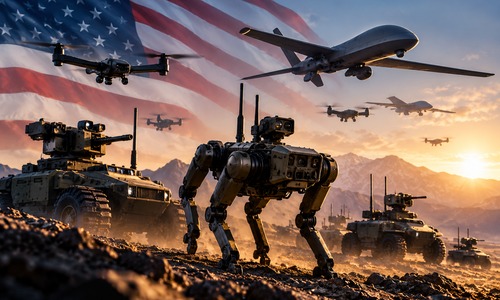
On September 30 at Quantico, Secretary of War Pete Hegseth announced something that deserves far more attention than another Pentagon reorganization.
Among six initiatives unveiled in his “State of the Force” address, Hegseth announced plans for a four-star Autonomous Warfare Command, or AUTOWARCOM, intended to build and scale autonomous and robotic capabilities across the Joint Force by October 2027. Project Agincourt, whose name evokes Henry V’s 1415 victory over a far larger French army, will lay the groundwork with new military specialties and faster acquisition pathways. Project Meridian will examine what technologies and capabilities future battlefields will demand.
“Lasting change must be anchored in military command structures,” Hegseth said. That sentence explains why Quantico matters. Experiments come and go. Commands endure.
Nine months earlier, at SpaceX’s Starbase, Hegseth declared that America would become an “AI-first warfighting force across all domains.” America would not win by bolting artificial intelligence onto old tactics, he said: “We will win by discovering entirely new ways of fighting.”
Quantico moves that vision from strategy to institution.
There are compelling reasons for doing so. The Pentagon’s latest China report finds that Beijing continues to develop military AI, and the People’s Liberation Army (PLA) is integrating AI into unmanned systems, cyber operations, and other military applications. America cannot assume potential adversaries will wait while we debate the implications.
But history also warns against confusing technological superiority with military superiority. American forces have prevailed against technically superior weapons, such as Germany’s Tiger tank, because training, doctrine, logistics, mass, and human judgment also decide battles.
The harder question is whether we are building dependence on autonomous warfare faster than we are building the institutions capable of governing it.
Hegseth’s January AI Acceleration Strategy reaches across warfighting, intelligence, and military administration. Among its seven priority projects is Agent Network, intended to develop AI-enabled battle management and decision support extending from campaign planning to what the Pentagon calls “kill chain execution.” Another project, Swarm Forge, is intended to experiment with AI-enabled capabilities and discover new ways of fighting with and against them.
I recently wrote about what that means for a commander who has seconds to decide after machines have assembled the picture, ranked the threats, and narrowed the options. A human may remain “in the loop” and still exercise little independent judgment. Human authorization is not the same thing as human judgment, and the gap between them widens as machines take on more of the thinking.
The Pentagon already requires autonomous weapon systems to permit “appropriate levels of human judgment over the use of force.” The directive never defines how much judgment is appropriate once a machine has already shaped what the commander knows.
var images = [],
index = 0;
images[0] = ““;
images[1] = ““;
images[2] = ““;
images[3] = ““;
index = Math.floor(Math.random() * images.length);
document.write(images[index]);
//done
For most of military history, technology extended man’s physical capabilities. Gunpowder increased destructive power. Aircraft conquered distance. Radar extended perception. Computers accelerated calculation.
Artificial intelligence reaches farther. It now performs analysis, interpretation, prediction, and recommendation, cognitive work once reserved for commanders and their staffs. As machines take on that work at a speed and scale no staff can match, the officer’s role shifts from producing analysis to questioning, validating, and judging what the machine produces.