
For years, the nightmare scenario surrounding artificial intelligence and warfare has looked something like science fiction: autonomous weapons making their own decisions, computers selecting targets, machines eventually removing human beings from the process of deciding who lives and who dies.
But we may have been worrying about the wrong nightmare.
AI does not need control of a missile to help start a war. It only needs to convince a human being that the missile needs to be launched.
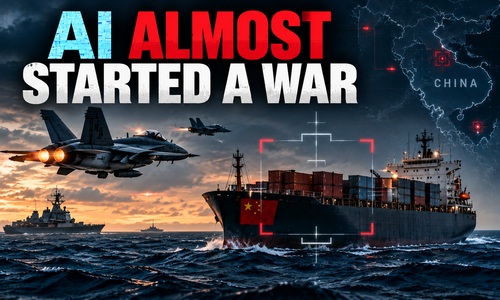
A remarkable incident inside the U.S. military earlier this year offers a glimpse of just how dangerous that possibility has become. According to CNN, an intelligence report circulated within the military claiming that a Chinese vessel traveling in the Middle East was carrying components connected to a nuclear weapons program.
The report set off alarms.
American forces began preparing to intercept the vessel. Armed personnel were reportedly preparing to board it. Military aircraft were sent into the air.
Then, just before the operation moved forward, officials took a closer look.
The intelligence was wrong.
Not slightly wrong. According to one source familiar with the incident, it was “entirely false.” Investigators discovered that an analyst had used artificial intelligence in producing the report and that a chatbot had incorrectly identified what the Chinese ship was carrying.
One source told CNN the incident “almost started a war.”
That may sound dramatic. But consider what could have happened if American military personnel had actually attempted to board a Chinese vessel based upon a false accusation involving nuclear weapons.
This was not an AI laboratory experiment.
Military forces were reportedly already moving.
The Human Was Still In The Loop
One of the most common reassurances about military artificial intelligence is that humans will remain in control.
A machine might analyze intelligence. It might identify threats. It might recommend targets. It might help commanders make decisions.
But ultimately, we are told, a human being will make the final call.
This incident exposes the weakness in that reassurance.
Humans can remain completely in control while still making disastrous decisions based upon information supplied by machines.
The AI doesn’t need authority to order an attack. It can simply provide the intelligence upon which a human commander orders one.
That distinction becomes increasingly important as the Pentagon moves aggressively to integrate AI throughout the military. Its 2026 AI strategy calls for accelerated integration across warfighting, intelligence and enterprise operations, including AI-enabled battle management and decision support stretching from campaign planning into the “kill chain.” The Defense Department has been pursuing AI for command and control, operational planning, intelligence activities, autonomous systems and other military applications for years.
The objective is understandable: speed.
Modern warfare moves extraordinarily quickly. The military that identifies a threat, understands it and responds first may gain an enormous advantage.
But speed comes with a terrifying downside.
It gives you less time to discover that you are wrong.
var images = [],
index = 0;
images[0] = ““;
images[1] = ““;
images[2] = ““;
images[3] = ““;
index = Math.floor(Math.random() * images.length);
document.write(images[index]);
//done
What If Nobody Had Checked?
That may be the most disturbing question emerging from this episode.
Someone apparently did what we would hope a human being would do: questioned the intelligence.
Officials dug deeper.
The error was discovered.
The operation did not proceed.
But what happens next time?
What happens when the intelligence appears even more convincing? What happens during an actual crisis when commanders believe they have minutes rather than hours to react? What happens when several AI systems independently repeat information that originated from the same false source?
Most importantly, what happens when the opposing military begins reacting before anyone discovers the mistake?
Imagine a future confrontation in the Pacific.
An AI system mistakenly identifies preparations for a Chinese attack. American commanders respond by repositioning aircraft and ships. Chinese surveillance detects those movements and interprets them as preparations for an American strike.
American AI systems detect China’s response and conclude that the original warning was correct.
Missiles are placed on alert.
Commanders suddenly have minutes to determine whether the enemy is preparing to attack.
But each side’s response makes the other side increasingly convinced that war is coming.
That is how an AI hallucination could become a military reality.
The Race To Make War Faster
The danger becomes even greater because America cannot develop military AI in isolation.