
Imagine telling Americans fifty years ago that a government meeting in the heartland would one day open with an invocation ending in “Hail Satan”—and that officials would defend the speaker’s right to deliver it.
They might have thought you were describing a dystopian novel about America’s future.
Welcome to Ottumwa, Iowa, in 2026.
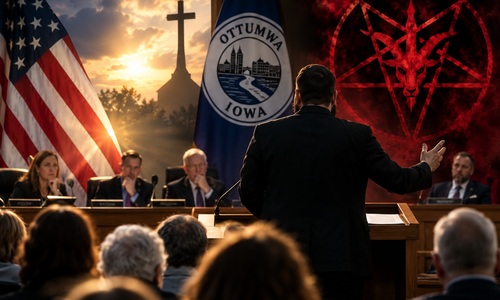
On October 6, former city council member Matt Dalbey stood before elected officials and delivered an invocation associated with The Satanic Temple, concluding with those two words: “Hail Satan.”
Pastor Rick Bick of New Life Center immediately objected, declaring that the invocation amounted to a curse upon the city. But the city defended its policy of allowing diverse religious viewpoints, explaining that it could not discriminate against particular denominations.
And there, in one extraordinary moment, was a snapshot of America’s spiritual transformation.
A nation that once took public acknowledgment of God for granted is now debating whether invoking Satan at city hall is simply another expression of religious diversity.
The controversy isn’t really about one invocation in one Iowa town. It’s about how far America’s spiritual foundations have eroded—and how easily Christians have become accustomed to watching it happen.
The Revolution Didn’t Happen Overnight
Nobody woke up one morning and decided America should replace Christianity with Satanism. That isn’t what happened, and it isn’t necessary for understanding the danger.
The transformation has been slower, more subtle, and arguably more effective.
For decades, Americans have watched battles over prayer in schools, Ten Commandments displays, nativity scenes, and public expressions of biblical morality. Religious traditions once considered ordinary have increasingly become subjects of litigation, controversy, and demands for government neutrality.
Meanwhile, Christianity’s influence over American culture has steadily weakened.
Biblical teachings about marriage, sexuality, human life, and moral responsibility are now frequently portrayed as outdated, intolerant, or even harmful. In many influential institutions, the question is no longer whether Christian values should guide society, but whether those values should have any privileged place in public discussion.
And into that vacuum have stepped competing philosophies, ideologies, and spiritual movements.
The result isn’t necessarily a society without religion. It’s a society increasingly willing to embrace almost anything except the idea that biblical Christianity possesses unique authority.
That’s what makes Ottumwa so revealing.
The controversy wasn’t over whether the invocation was spiritually appropriate. The official question was whether the city had followed its religious inclusion policy.
A prayer invoking Satan had become an administrative matter.
var images = [],
index = 0;
images[0] = ““;
images[1] = ““;
images[2] = ““;
images[3] = ““;
index = Math.floor(Math.random() * images.length);
document.write(images[index]);
//done
Satan Doesn’t Have To Be Real To Them For The Message To Be Real
Defenders of The Satanic Temple frequently point out that its members generally don’t believe in a literal Satan.
That’s true. The organization describes itself as nontheistic, presenting Satan as a symbol of rebellion against arbitrary authority.
But consider the implications.
Of all the symbols available to represent freedom, independence, or resistance, the organization deliberately chose the figure Christianity identifies as the enemy of God.
That choice is not accidental.
The Satanic Temple has pursued campaigns involving public invocations, religious displays, and After School Satan Clubs, frequently seeking access to spaces where Christian religious expression has already been permitted.
Its strategy uses the language of religious equality to challenge Christianity’s historic position in public institutions.
The objective is not necessarily to persuade Americans to worship a literal devil. It is to force a confrontation over whether Christian expression deserves any special standing in public life.
And the symbolism is powerful precisely because Christians understand what Satan represents.
For Christians, Satan is not a mascot for individual liberty. Scripture describes him as a deceiver, a destroyer, and the adversary of God.
Calling him a metaphor does not erase the meaning of deliberately invoking his name.
Imagine a society so disconnected from its Christian heritage that the invocation of Satan is treated as harmless symbolism while biblical teachings are increasingly regarded as dangerous.
That is the cultural contradiction worth examining.
Religious Freedom Is Not The Same As Spiritual Neutrality
There is an important constitutional reality here.
The First Amendment protects the religious freedom of Christians, atheists, Satanists, and everyone else. A city that opens its invocation program to diverse beliefs generally cannot exclude someone simply because officials find the message offensive.
Christians should defend that principle. Government power used to silence an unpopular religious viewpoint today can be used against biblical Christianity tomorrow.
But something deeply troubling happens when legal neutrality becomes the measure of a society’s spiritual health.
A government may be required to permit an invocation without endorsing it. That does not mean citizens must pretend every invocation carries the same spiritual meaning.
The law can recognize equal rights without declaring all beliefs equally true.
And Christians should not confuse the two.
America’s founders established protections against government-imposed religion. They did not establish a moral universe in which truth and falsehood, good and evil, and God and Satan become interchangeable simply because the government must protect freedom of conscience.