
For generations, Christians watching developments in Israel have assumed that one enormous event must occur before biblical sacrifices can return to Jerusalem: the Third Temple must first be built.
But what if that assumption is wrong?
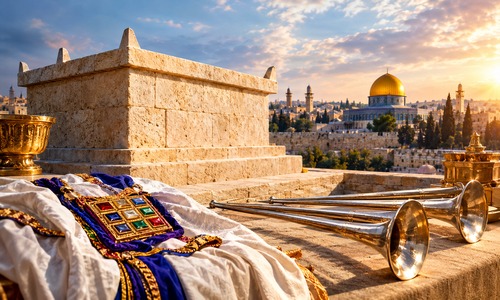
According to Rabbi Tovia Singer, one of the most widely followed Jewish teachers in the world, an altar suitable for Temple sacrifices has already been prepared. The priestly garments have been made. Silver trumpets have been fashioned. Other vessels necessary for Temple worship have been recreated.
And according to Singer, the altar is ready to be taken to the Temple Mount.
“We have an altar that’s ready to go,” Singer recently explained. “It’s built. It’s here. It’s ready to go on the Temple Mount.”
Then came the statement that should catch the attention of every student of Bible prophecy:
“You technically do not need a Temple in order for an altar to be placed there and sacrifices to be offered.”
That changes the conversation considerably.
For years, prophecy watchers have focused primarily on the enormous political obstacles to rebuilding the Jewish Temple. The Temple Mount contains the Dome of the Rock and Al-Aqsa Mosque and remains perhaps the most religiously explosive piece of real estate on earth. Any serious attempt to construct a Jewish Temple there could produce repercussions across the Middle East.
But rebuilding the Temple and resuming sacrifices may not necessarily be the same event.
The biblical precedent is found in Ezra.
When Jewish exiles returned from Babylon to Jerusalem in the sixth century B.C., they found their city devastated and Solomon’s Temple destroyed. Yet they did not wait until a new Temple could be constructed before restoring biblical worship.
They built the altar first.
Ezra 3:6 makes the sequence unmistakable:
“From the first day of the seventh month began they to offer burnt offerings unto the LORD. But the foundation of the temple of the LORD was not yet laid.”
The Temple wasn’t standing.
Its foundation hadn’t even been laid.
Yet sacrifices had already begun.
That ancient precedent suddenly makes today’s Temple preparations considerably more interesting.
The Altar Is No Longer Theoretical
Organizations connected with the Temple movement have spent decades preparing for a restoration that most of the world considers politically impossible.
But they have not merely held conferences or produced architectural drawings.
The Temple Institute in Jerusalem has recreated numerous vessels associated with biblical Temple worship. Priestly garments have been produced according to extensive study of biblical and rabbinic requirements. A large golden menorah stands prominently in Jerusalem’s Old City as a visible symbol of those preparations.
Singer says the altar itself has also been prepared.
Its stones present an unusual challenge because Exodus specifically prohibits using stones shaped by iron tools for an altar.
“If thou lift up thy tool upon it, thou hast profaned it,” Exodus 20:25 declares.
Singer says the stones were therefore prepared without metal touching them.
The symbolism behind the command is striking. Jewish tradition explains that iron represents instruments of warfare and death, while the altar represents reconciliation and atonement. An instrument that shortens life therefore should not be used to construct something intended to preserve it.
Whether one accepts every rabbinic interpretation surrounding the Temple service is beside the point.
The people making these preparations are not building theatrical props.
They intend these objects to be usable.
var images = [],
index = 0;
images[0] = ““;
images[1] = ““;
images[2] = ““;
images[3] = ““;
index = Math.floor(Math.random() * images.length);
document.write(images[index]);
//done
Preparation Is Not Permission
None of this means sacrifices are about to begin.
Moving an altar onto the Temple Mount would be extraordinarily controversial. The site’s religious sensitivities, Israeli government policy, Jordan’s custodial role regarding Muslim holy sites and the reaction throughout the Islamic world create enormous obstacles.
An altar can be ready while the political circumstances necessary to use it remain nowhere in sight.
But there is an enormous difference between something being politically impossible and something being physically unprepared.
Political conditions can sometimes change almost overnight.
The physical preparations that might otherwise require years have increasingly already been made.
And that is where these developments become especially significant for Christians interested in Bible prophecy.