
For generations, Christians reading biblical prophecy have wrestled with a basic practical question: How could the nations of the world ever surrender enough sovereignty for anything resembling a truly global system of government to emerge?
Perhaps the answer isn’t that humanity will suddenly fall in love with global government.
Perhaps humanity will become afraid of something it believes only global government can control.
That possibility has become considerably more interesting as artificial intelligence races forward. And billionaire technology investor Peter Thiel–who has spent considerable time publicly discussing the Antichrist, Armageddon and the dangers of global governance–has now made a striking observation.
Asked by Mathias Döpfner what it would actually take to slow the international AI race, Thiel said meaningful restraint would require extraordinary worldwide cooperation.
“In theory, you could slow it down if you had genuine, deep cooperation across the whole world,” Thiel said.
But then came the important part.
Such cooperation, he argued, would require something resembling “a one world government with real teeth, real force.”
Thiel immediately warned that such a solution could be worse than the problem itself.
That should get our attention.
Because AI may be creating something historically unusual: a global problem that governments eventually conclude cannot be solved by national governments.
And here is the deeper danger.
AI could simultaneously create the crisis used to justify global government–and provide the technological machinery necessary to operate it.
The Problem No Country Can Solve Alone
Imagine Washington decides tomorrow that advanced AI development has become too dangerous.
America imposes strict limits on computing power, advanced chips and AI training.
What happens if China doesn’t?
Or a private organization operating beyond American jurisdiction?
The competitive pressure becomes enormous. No major power wants to stop developing a technology that could determine future military superiority, intelligence capabilities, economic dominance and scientific advancement while its rivals continue racing ahead.
Thiel himself raised essentially this problem. Western restrictions could simply leave competitors–particularly China–continuing their development.
That means genuinely stopping or significantly slowing AI would require more than American legislation.
It would require global cooperation.
But cooperation isn’t enough if countries can cheat.
Eventually someone must inspect.
Someone must monitor.
Someone must enforce.
And suddenly the discussion has moved from international cooperation toward international authority.
That is precisely where Thiel’s phrase becomes so important: a global authority with “real teeth” and “real force.”
The Crisis Changes. The Argument Remains
Humanity has already heard versions of this argument.
Climate change crosses borders.
Pandemics cross borders.
Nuclear weapons threaten everyone.
Financial crises spread internationally.
Biological weapons could affect the entire planet.
And now artificial intelligence may eventually present another version of the same proposition: the threat is global, therefore the solution must also be global.
But AI is different in one particularly important respect.
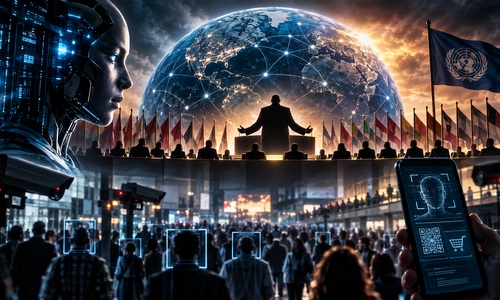
The technology needed to monitor AI could create an infrastructure capable of monitoring humanity itself.
Consider what serious global AI enforcement might eventually require.
Authorities could demand knowledge of who possesses advanced processors, where massive computing clusters are operating, what models are being trained, how much computing power organizations possess and whether companies or governments are secretly developing prohibited systems.
That could require unprecedented visibility into data centers, communications networks, financial transactions, semiconductor supply chains and digital infrastructure.
Now combine that with increasingly sophisticated AI surveillance.
Automated financial monitoring.
Behavioral analysis.
Algorithmic censorship.
Predictive policing.
Centralized digital payment systems.
None of these technologies independently constitutes the prophetic system described in Revelation. Christians should be careful about declaring every technological development the fulfillment of a particular prophecy.
But neither should we ignore what is happening before our eyes.
The technological architecture necessary for extraordinary centralized control is becoming increasingly conceivable.
var images = [],
index = 0;
images[0] = ““;
images[1] = ““;
images[2] = ““;
images[3] = ““;
index = Math.floor(Math.random() * images.length);
document.write(images[index]);
//done
Thiel Has Been Warning About This For Years
What makes Thiel’s latest remarks particularly fascinating is his previous discussion of the Antichrist.
In his public conversations and 2025 lectures, Thiel explored the possibility that fear of existential catastrophe could become the justification for unprecedented global political authority.
His framework presents a disturbing dilemma.
Humanity becomes terrified of Armageddon–nuclear war, runaway technology, biological catastrophe or some other existential threat–and eventually accepts enormous centralized power from whoever promises to prevent it.
In other words, global government doesn’t necessarily arrive because humanity suddenly embraces the idea.
It arrives because humanity becomes convinced that the alternative is catastrophe.
That possibility should sound familiar to students of biblical prophecy.
Revelation describes a future system possessing extraordinary political and economic control. Revelation 13 famously describes a system in which participation in economic life–buying and selling–becomes connected to allegiance to the Beast.
For most of history, people could understand the theological warning while struggling to imagine the practical mechanics.