
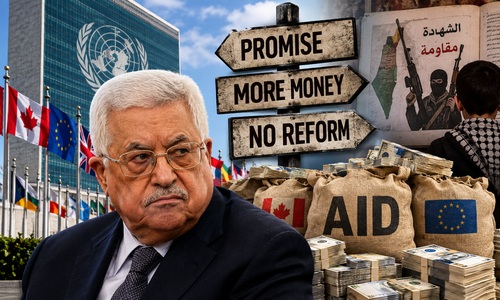
Mahmoud Abbas stood before the United Nations last week–virtually–and delivered an astonishing message to the world.
The Palestinian Authority’s reform job is essentially finished.
“We have completed the national reform program,” Abbas declared, claiming his government had strengthened transparency, accountability, financial management, the rule of law and the fight against corruption.
He said the Palestinian welfare system had been transformed. Education was being reformed according to international standards. Democratic renewal was underway. The Palestinian leadership rejected terrorism, extremism, antisemitism and hatred.
There was just one problem.
Nine days earlier, the United States government had reached almost the opposite conclusion.
The State Department reported that the Palestinian Authority and Palestine Liberation Organization had “once again failed to live up to their commitments,” specifically accusing them of continuing payments to terrorists and glorifying terrorists through public statements and school textbooks. Washington responded by extending visa sanctions against PA and PLO officials.
So which Palestinian Authority are we talking about?
The transformed institution Abbas described at the UN?
Or the institution the United States says continues practices the international community has demanded it abandon?
Increasingly, that question doesn’t seem to matter–because the money keeps coming anyway.
Another Crisis, Another Check
Canada announced another C$100 million in assistance for Palestinians during the UN General Assembly meetings while the European Union has proposed a €1.6 billion program through 2027. That includes €620 million in direct financial assistance to the Palestinian Authority, which the European Commission says is partially linked to reform commitments.
But what actually happens when the Palestinian Authority doesn’t reform?
Apparently, another opportunity to reform.
Pay-For-Slay Gets A New Name
Consider perhaps the most notorious issue.
Abbas abolished the old prisoner-payment system and announced a new social welfare arrangement supposedly based upon financial need rather than a prisoner’s offense or sentence.
Not according to the U.S. government.
An April State Department report to Congress concluded that despite changing the mechanism, the PA continued providing payments and benefits to terrorists and their families. According to the report, approximately $156 million was paid during 2025.
Its conclusion was devastatingly simple: the PA continued a system of compensation supporting terrorism through “new mechanisms and under a different name.”
var images = [],
index = 0;
images[0] = ““;
images[1] = ““;
images[2] = ““;
images[3] = ““;
index = Math.floor(Math.random() * images.length);
document.write(images[index]);
//done
What Are Palestinian Children Still Being Taught?
Education provides another test.
Abbas told the UN that Palestinian education was being reformed according to international standards.
Yet IMPACT-se examined 290 textbooks and 71 teacher guides from the 2025-26 Palestinian curriculum and concluded they remained substantively unchanged from previous editions.
Its researchers documented material they classified as promoting jihad and martyrdom, glorifying terrorism, encouraging antisemitism, rejecting peacemaking and erasing Israel from maps.
If the next generation continues being taught many of the narratives the international community has spent years demanding be removed, what exactly has been reformed?
Reforming Democracy Without Elections
Then there is democracy.
Abbas speaks about “democratic renewal,” yet Palestinians have not held legislative elections since 2006.
That may finally change. Abbas has decreed legislative elections for November 28, 2026, with presidential elections expected in 2027. Naturally his hand picked successor, Hussein al-Sheikh is expected to win and continue his policies.
But promising an election is not the same thing as holding one.
Palestinian human-rights organization Lawyers for Justice continues documenting allegations of political detention, restrictions on expression and disregard for judicial release orders. Its latest annual report was released just one day before Abbas addressed the UN.