

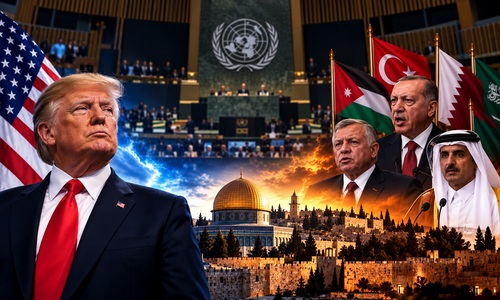
For several days, world leaders have walked to the same podium in New York and spoken about war, security, artificial intelligence, climate, international law and the future. But listen carefully and something much bigger emerges.
They are describing two very different visions of how the world should be governed.
One places national sovereignty at the center. Nations cooperate when it serves their interests but ultimately retain control over their laws, borders, technology, military and foreign policy. The other places growing emphasis on multilateralism: stronger international institutions, global standards, international law and coordinated action when individual governments refuse to follow an emerging international consensus.
And remarkably, Israel is becoming one of the clearest fault lines separating those two visions.
America: We Will Decide For Ourselves
President Donald Trump’s message to the United Nations was unmistakable. America will cooperate, negotiate and maintain alliances, but it will not surrender its sovereignty to international institutions.
Trump denounced attempts by unelected “globalist bureaucrats” to dictate policy to sovereign nations. His administration has opposed the International Criminal Court and resisted efforts to place American technology under international oversight.
The underlying principle is straightforward: international cooperation, yes; international control, no.
UN Secretary-General António Guterres presented a markedly different vision. He argued that international institutions need to become stronger and that today’s challenges require shared rules, international cooperation and a revitalized multilateral system.
Artificial intelligence illustrates the divide. Guterres has called for a multilateral AI risk-management framework with independent oversight. Trump wants America leading the AI revolution without handing control of American technology to international regulators.
These are more than disagreements over bureaucracy. They are competing ideas about who ultimately gets to make the rules.
Then There Is Israel
Nowhere was the divide more visible than Israel.
Turkish President Recep Tayyip Erdoğan used his UN appearance to demand greater international pressure on Israel while again calling for dramatic reform of the international system. Jordan’s King Abdullah questioned why sanctions, embargoes and diplomatic isolation have been applied elsewhere while international resolutions concerning Israel repeatedly remain unenforced. Qatar’s emir likewise demanded greater pressure on Israel and urged additional countries to recognize a Palestinian state.
France, Britain and Canada have moved toward greater coordination over Palestinian statehood and measures intended to preserve a two-state solution. Guterres told a high-level meeting that support for Palestinian statehood must move beyond declarations and become concrete “policies, decisions and actions.”
That language deserves attention because the debate is increasingly moving from condemnation toward consequences: sanctions, trade restrictions, arms limitations, international court actions and diplomatic pressure.
The mechanisms already exist. What has often been missing is sufficient international agreement to use them.
var images = [],
index = 0;
images[0] = ““;
images[1] = ““;
images[2] = ““;
images[3] = ““;
index = Math.floor(Math.random() * images.length);
document.write(images[index]);
//done
America Stands Apart
One recent UN vote provided an extraordinary snapshot of the divide. When the General Assembly considered allowing Palestinian Authority President Mahmoud Abbas to address the gathering virtually after Washington denied him a visa, the vote was 152-3.
Only Israel, the United States and Paraguay voted no.
Whatever one’s opinion of that particular resolution, the larger picture is difficult to miss. Israel and America stood together while most of the international community stood somewhere else.
That raises a much bigger question: What happens if America eventually moves?