

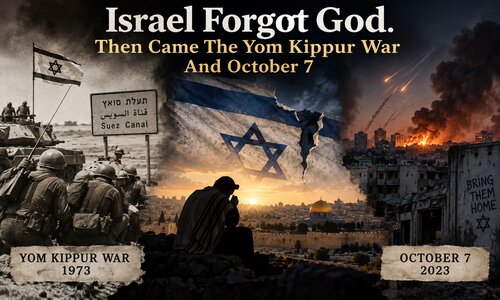
For Israelis, October 7, 2023 has changed the way we remember October 6, 1973. The two dates are separated by exactly fifty years, but they are joined by more than coincidence. Both were Jewish holidays. Both began with a devastating surprise attack by genocidal enemies. In both cases, Israel’s political and military leadership had convinced itself that it understood its enemies and that a major war was unlikely. In both cases, the first hours exposed the failure of that assumption in the most painful possible way.
But there is another connection between 1973 and 2023. Both wars raise the same question: How should Israel understand a catastrophic blow that does not end in defeat?
That question is at the heart of an important reassessment of the Yom Kippur War by Dr. Hagi Ben Artzi, a veteran of the Yom Kippur War and Religious Zionist scholar of Jewish thought who is also the brother in law of Prime Minister Netanyahu. Ben Artzi argues that Israelis have spent five decades remembering the Yom Kippur War primarily through the trauma of its opening days, while neglecting the extraordinary and miraculous military victory that followed. More importantly, he sees the war as part of a Divine process in which God deliberately shocked the Jewish people after Israel’s extraordinary victory in the 1967 Six-Day War.
Ben Artzi’s argument is particularly relevant now. If October 7 has taught Israelis anything, it is that the opening hours of a war do not necessarily tell us what the war means. And if 1973 is any guide, the Jewish people may spend decades arguing about the meaning of October 7 before the full consequences of that day become clear.
A recent discussion with Ben Artzi and Yoel Elitzur in Olam Katan makes this case with unusual force.
“A blow that would shake us, but not bring us down”
There is no question that the beginning of the Yom Kippur War was a disaster. On October 6, 1973, Egypt and Syria launched a coordinated surprise attack. Egyptian forces crossed the Suez Canal, while Syrian forces advanced into the Golan Heights. Israeli forces were caught unprepared and initially faced overwhelming enemy numbers. Thousands of Israeli soldiers were killed or wounded, and the country experienced a level of fear and uncertainty that was almost unimaginable after the triumph of 1967.
The Israeli government and military leadership badly misjudged the situation. The Agranat Commission later documented the surprise suffered by Israel’s political and military leadership and the severe conditions faced by the IDF in the opening days. Yet the same historical record also makes clear what happened next: Israel halted the Egyptian and Syrian advances, launched counteroffensives, crossed the Suez Canal and ended the war with Israeli forces approximately 101 kilometers from Cairo and 35 kilometers from Damascus.
For Ben Artzi, the distinction between the opening of the war and its conclusion is crucial. “The Holy One, blessed be He, made sure to give us a blow that would shake us, but not bring us down.” That is a very different way of remembering 1973. It does not deny the tragedy, but it insists that the tragedy was not the whole story.
Ben Artzi points to the extraordinary reversal on the battlefield. Israel began the war with Egyptian and Syrian armies penetrating its defenses. Three weeks later, the IDF had driven the Syrian army back, entered Syrian territory, crossed the Suez Canal and surrounded Egypt’s Third Army. The military situation at the end of the war was radically improved from the state of affairs before the war.
Yet the Israeli national memory has overwhelmingly focused on the catastrophic beginning of the war instead of its victorious conclusion.
Ben Artzi argues that there is a political reason Israelis remember the war this way. For decades, Israel’s Left has pointed to the Yom Kippur War as proof that expanding Israel’s borders will not help to keep Israel safe. In their view, Israel controlled the Sinai, the Golan Heights, Judea and Samaria, and still came under devastating attack. The lesson was clear: Israel’s security would come through giving up territory and making peace with its enemies, not through holding strategic land.
But the end of the war tells a very different story. Israel was attacked by surprise on two fronts and initially pushed back. Three weeks later, the IDF was deep inside Syria, had crossed the Suez Canal and had surrounded Egypt’s Third Army. Rather than proving that strategic depth had failed, Ben Artzi argues, the war showed exactly why it mattered. Israel had the land and the space to absorb a devastating surprise attack, recover and turn the war around.
var images = [],
index = 0;
images[0] = ““;
images[1] = ““;
images[2] = ““;
images[3] = ““;
index = Math.floor(Math.random() * images.length);
document.write(images[index]);
//done
The Six-Day War of 1967 transformed the Jewish people’s relationship with the Land of Israel. In six days, Israel defeated the armies of Egypt, Syria and Jordan and returned to the heart of its biblical homeland. Jerusalem was reunited, Judea and Samaria were liberated, and the Golan Heights and Sinai were captured as well. The victory was so overwhelming that it created a dangerous confidence.
Ben Artzi describes the mentality that took hold after 1967 in the biblical language of “kochi v’otzem yadi,” “my own power and the might of my hand” (Deuteronomy 8:17). Israel had just achieved what seemed impossible, and the stunning victory transformed the way many Israelis viewed the IDF. Instead of seeing the victory as an act of divine providence, they began to place their faith in Israel’s military power. The IDF had become so strong, they believed, that Israel could protect itself through its own strength alone.
Then came the Yom Kippur War.
Israeli troops fight off Syrian soldiers in the Golan Heights, in an area that was later named the Valley of Tears. Photo: IDF photo archives.
For Ben Artzi, this was not simply a failure of military intelligence. After the triumph of 1967, Israel began to believe too much in its own strength. The shock of the Yom Kippur War shattered that confidence and forced the Jewish people to confront a truth they had begun to forget: Israel’s survival depends not only on the strength of the IDF, but ultimately on God.
Yoel Elitzur experienced that lesson firsthand. A young reservist during the Yom Kippur War, Elitzur was among the first Israeli soldiers to cross the Suez Canal as the IDF turned the war around. For him, what happened in 1973 followed a pattern straight out of the Bible: Israel was humbled, reminded that military strength alone could not save it, and then granted an extraordinary victory.
“This is an even greater victory than the Six-Day War,” Elitzur says, “because we began from such an inferior position.”