
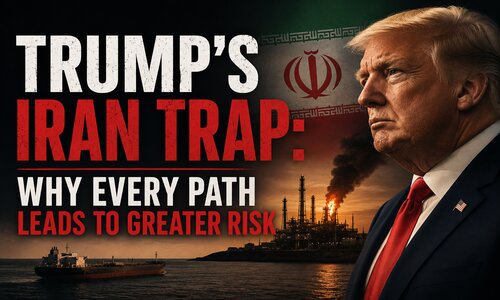
Donald Trump may command the world’s most powerful military, but today he faces an enemy that understands something equally powerful: time.
Iran no longer needs to defeat America on the battlefield. It only needs to make every available option so politically, economically and militarily painful that Washington hesitates. If that is Tehran’s strategy, it may already be working.
Over the past several weeks, President Trump has repeatedly signaled that military action remained on the table, only to pause again as negotiations resumed. On the surface, the decision appears understandable. Iran has already demonstrated its willingness to disrupt maritime traffic and threaten one of the world’s most important energy corridors. But military planners fear something far worse than the current standoff.
The real nightmare scenario is not simply more interference with shipping through the Strait of Hormuz. It is a coordinated Iranian campaign against the oil fields, refineries, export terminals, pipelines and energy infrastructure of America’s Gulf allies.
Such attacks would not merely slow the movement of oil–they could temporarily cripple the Gulf’s ability to produce and export it altogether. The result could be one of the largest energy shocks the modern world has experienced in decades, sending oil prices sharply higher, reigniting inflation, rattling financial markets and placing enormous strain on economies already burdened by debt and slowing growth.
That is the real trap confronting the White House.
Every Option Carries A Price
Rarely does a president face a foreign policy decision where every available path carries significant consequences.
If Trump authorizes a major military operation, Iran’s retaliation would likely extend well beyond attacks on American military bases. Tehran has repeatedly warned that Gulf nations assisting U.S. military operations could see their own energy infrastructure become targets. Oil fields, refineries, export terminals, pipelines, desalination plants and electrical facilities across Saudi Arabia, the United Arab Emirates, Bahrain and other neighboring states could suddenly find themselves on the front lines.
That distinction is critical.
Closing or disrupting the Strait of Hormuz creates a transportation crisis.
Destroying or severely damaging Gulf energy infrastructure creates a production crisis.
One delays oil deliveries.
The other reduces the world’s ability to produce millions of barrels of oil each day.
The difference is enormous.
Unlike a tanker waiting for safe passage, a destroyed refinery cannot simply resume operations overnight. Damaged export terminals take time to repair. Pipeline networks require reconstruction. Production lost from major oil fields cannot always be immediately replaced elsewhere, particularly when global spare production capacity is limited.
The consequences would ripple through nearly every sector of the global economy.
Oil prices could surge dramatically. Gasoline and diesel prices would climb. Airlines, trucking companies and manufacturers would face soaring operating costs. Inflation–which many central banks have spent years trying to bring under control–could return with renewed force. Stock markets would likely react sharply, consumer confidence could weaken, and nations already struggling with high debt and slowing economic growth could once again find themselves confronting recession.
In other words, what begins as a military conflict in the Persian Gulf could quickly become a global economic crisis affecting families thousands of miles from the battlefield.
These are not theoretical concerns. They are precisely the kinds of scenarios military planners are attempting to prevent.
var images = [],
index = 0;
images[0] = ““;
images[1] = ““;
images[2] = ““;
images[3] = ““;
index = Math.floor(Math.random() * images.length);
document.write(images[index]);
//done
Iran’s Most Powerful Weapon May Not Be Its Missiles
Iran cannot match America’s conventional military strength.
Instead, Tehran may be pursuing something far more effective.
Its greatest strategic weapon may be the fear of what a wider conflict would do to the global economy.
Threaten the Strait of Hormuz.
Threaten Gulf oil infrastructure.
Threaten commercial shipping.
Threaten regional energy production.
Suddenly, military decisions are no longer measured solely by battlefield success. They become measured by gasoline prices, inflation, financial markets, insurance costs and political consequences back home.
If an adversary can convince its opponent that the economic consequences of military action are simply too costly, overwhelming military superiority begins to lose some of its advantage.
That should concern every American–not only in this conflict, but in future confrontations with other adversaries.
Can America Fight On An Election Calendar?
Every president must weigh military decisions alongside domestic realities.
No responsible commander-in-chief ignores the possibility of American casualties, economic disruption or broader regional escalation.
But America’s adversaries understand those realities too.
Iran knows elections matter.
It knows rising gasoline prices matter.
It knows public opinion matters.