

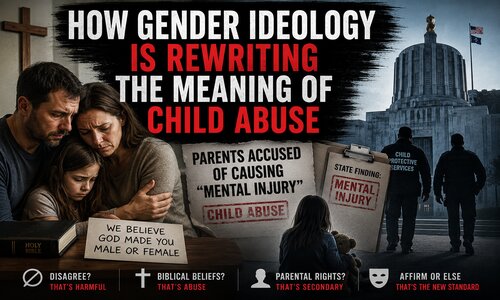
For generations, child abuse was understood in clear and tragic terms: physical violence, sexual abuse, abandonment, or severe neglect. Today, however, a growing ideological movement is attempting to redefine abuse itself. In some cases, a parent’s refusal to affirm a child’s transgender identity is no longer viewed as a moral or religious conviction–it is increasingly portrayed as psychological harm.
A lawsuit filed against Oregon’s Department of Human Services (ODHS) has brought that troubling trend into the spotlight.
The case centers on a Christian family whose teenage daughter identified as transgender. After the parents rejected gender affirmation based on their biblical convictions and sought to expose their daughter to alternative viewpoints, state officials concluded they had caused “mental injury.”
Their daughter was removed from the home, and the parents were later placed on a child abuse registry. The family has now filed a federal lawsuit, arguing that state officials violated their constitutional rights to direct the upbringing of their child while targeting them for their religious beliefs.
Regardless of how the courts ultimately rule, the case raises a question that reaches far beyond one Oregon family:
When does disagreement become abuse?
The New Definition Of Harm
The heart of this controversy is not simply transgender ideology. It is the expanding definition of what government considers “harm.”
Children frequently become upset with parents. They dislike discipline, curfews, restrictions on dating, limits on social media, and countless other parental decisions. Parents routinely challenge their children’s beliefs because that is part of raising them into mature adults.
But if emotional distress caused by disagreement is itself labeled “mental injury,” nearly any parent who teaches unpopular moral convictions could someday find themselves under government scrutiny.
That represents a dramatic shift from protecting children against abuse to protecting children from ideas they find emotionally uncomfortable.
A Broader Ideological Shift
The Oregon lawsuit is not an isolated event. Across North America and Europe, parents who decline to affirm a child’s self-declared gender identity increasingly find themselves at odds with schools, medical professionals, and government agencies.
Some states have enacted laws making it easier for minors to access gender-related services without parental involvement. School districts have faced criticism for withholding information from parents regarding students’ gender identities. In Canada and parts of Europe, legal and professional standards surrounding gender affirmation have also moved in directions that concern many religious families.
Taken together, these developments suggest something much larger than a single custody dispute. They reflect a growing worldview in which affirmation is viewed as compassion, while disagreement–even when rooted in sincere religious conviction–is increasingly treated as emotional harm.
var images = [],
index = 0;
images[0] = ““;
images[1] = ““;
images[2] = ““;
images[3] = ““;
index = Math.floor(Math.random() * images.length);
document.write(images[index]);
//done
Competing Views Of Human Identity
At its core, this conflict is not political–it is theological.
Christianity teaches that God intentionally created humanity male and female and that our identity is ultimately received from our Creator rather than self-defined. Gender ideology, by contrast, teaches that internal feelings determine identity and that society has a moral obligation to affirm those feelings.
These worldviews cannot both be true.
As governments, schools, and professional organizations increasingly embrace one worldview, those who hold the other inevitably face growing pressure.
The concern for many Christian parents is not merely that they disagree with prevailing cultural norms, but that disagreement itself is increasingly portrayed as dangerous.