
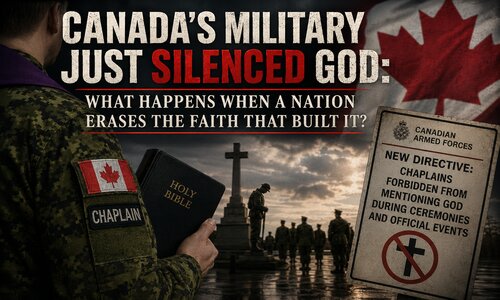
Canada has long prided itself on being a nation of tolerance, diversity, and freedom. Yet one of its latest military directives raises a troubling question: How tolerant is a society that increasingly excludes Christianity from public life?
The Canadian Armed Forces has reportedly issued guidance instructing military chaplains to avoid using religious-specific language–including references to God–during public ceremonies and official events. The irony is difficult to ignore. Chaplains exist precisely because they are ministers of faith. Asking them to leave God out of public prayers is rather like asking a physician to avoid mentioning medicine.
Even more striking is the fact that Canada’s own national anthem still asks God to “keep our land glorious and free.” Apparently, the nation may sing about God, but those officially appointed to provide spiritual care are increasingly discouraged from speaking His name.
This is about far more than military protocol. It reflects a profound shift in how Canada understands its own history, identity, and future.
The Faith That Helped Build A Nation
Modern Canada did not emerge in a spiritual vacuum.
For centuries, Christian missionaries established many of the country’s earliest schools, hospitals, and charitable institutions. Churches played a central role in caring for the poor, educating children, and building communities across an often harsh and unforgiving landscape.
The nation’s constitutional foundations also reflected this heritage. Canada’s Constitution Act, 1982 begins with the declaration that “Canada is founded upon principles that recognize the supremacy of God and the rule of law.” Whether every Canadian today personally embraces Christianity is beside the point. The country’s legal and moral framework openly acknowledged that rights ultimately came from a higher authority than the state.
That understanding has enormous implications.
When governments recognize God, they implicitly recognize limits on their own power. Human rights are viewed as inherent–not merely privileges granted by politicians. Freedom of conscience, freedom of worship, and freedom of speech become protected because they are understood to flow from something greater than government itself.
When that foundation is gradually removed, rights become increasingly vulnerable to the shifting priorities of whoever happens to hold political power.
Christians Have Always Served Canada
The irony of this directive becomes even sharper when considering the sacrifices Christians have made in Canada’s defense.
Thousands of Canadian soldiers who stormed the beaches of Normandy, fought through Europe, or served in Korea, Afghanistan, and countless peacekeeping missions carried Bibles in their packs and prayed before entering battle.
Military chaplains have stood beside wounded soldiers, comforted grieving families, buried the dead, and offered hope in humanity’s darkest moments. They have ministered during wars, natural disasters, and national tragedies. Their role has never been simply ceremonial–it has been deeply spiritual.
Many soldiers sought them precisely because they wanted someone willing to speak honestly about God, eternity, forgiveness, courage, and hope.
Now those same chaplains are increasingly expected to provide spiritual care while carefully avoiding the very faith that defines their calling.
var images = [],
index = 0;
images[0] = ““;
images[1] = ““;
images[2] = ““;
images[3] = ““;
index = Math.floor(Math.random() * images.length);
document.write(images[index]);
//done
Neutrality Or Secular Preference?
Supporters of these policies often argue they promote neutrality in an increasingly diverse military.
But genuine neutrality treats all beliefs equally.
What increasingly appears to be happening across much of the Western world is not neutrality but the elevation of secularism into the preferred public worldview. Religious expression is welcomed only so long as it remains private and invisible.