

You don’t have to work on Wall Street to care about Treasury yields. You don’t have to own a farm to care about diesel prices. And you don’t have to be shopping for a house to care about mortgage rates.
Eventually, these numbers have a way of finding all of us.
America is entering a period in which several economic warning signs are flashing at the same time. None of them, by itself, proves that a recession or financial crisis is around the corner. In fact, parts of the economy remain remarkably resilient.
But taken together, they tell us something important: the financial pressure on American households is becoming increasingly difficult to ignore.
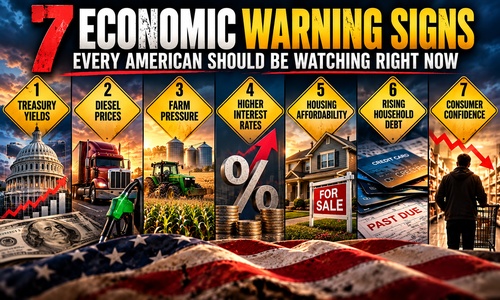
Here are seven warning signs worth watching.
1. Treasury Yields Are Sending A Warning
The bond market rarely makes dinner-table conversation, but perhaps it should.
Long-term Treasury yields have recently climbed to levels not seen in decades, with the 30-year yield reaching its highest level since 2004.
Why should the average American care?
Because Treasury yields influence borrowing costs throughout the economy. Mortgages, business loans and other forms of credit are affected by what happens in the bond market.
Higher government borrowing costs also matter because Washington must continually refinance an enormous national debt. The more expensive that becomes, the larger the government’s interest burden becomes.
A move in Treasury yields may look like something happening on a trader’s computer screen. Eventually, however, the consequences can reach Main Street.
2. Diesel Has Become Everybody’s Problem
Diesel recently surged above $6 per gallon nationally, hitting record territory. Farmers have been particularly hard hit during one of the most fuel-intensive periods of the year.
But this isn’t just a farmer problem.
Diesel powers tractors, combines and other agricultural equipment. It powers the trucks transporting produce, meat and dairy products. It moves construction equipment and countless commercial vehicles.
In other words, much of the physical economy runs on diesel.
When farmers spend dramatically more to harvest crops and truckers spend dramatically more to move them, somebody eventually has to absorb those costs. Businesses can swallow them temporarily, but not indefinitely.
That means the diesel price displayed at a truck stop hundreds of miles away may eventually appear in your grocery receipt.
3. America’s Farmers Are Being Squeezed
Diesel isn’t the only problem confronting agriculture.
The USDA expects inflation-adjusted net farm income to decline 5.5 percent in 2026. Meanwhile, total farm-sector debt is projected to climb 4.6 percent to approximately $605 billion.
Those numbers deserve more attention than they receive.
America’s food supply depends upon producers who face many of the same problems households do: higher borrowing costs, higher energy costs and expensive inputs. Farmers cannot simply stop planting or harvesting because diesel, fertilizer or financing became too expensive.
They have to make the numbers work.
When they can’t, they borrow more, cut expenses, postpone equipment purchases or eventually leave the business.
Americans may live hundreds of miles from the nearest farm, but every family visits a grocery store. What happens in farm country doesn’t stay in farm country.
var images = [],
index = 0;
images[0] = ““;
images[1] = ““;
images[2] = ““;
images[3] = ““;
index = Math.floor(Math.random() * images.length);
document.write(images[index]);
//done
4. Interest Rates Are Moving The Wrong Direction Again
The Federal Reserve raised its benchmark interest rate by a quarter percentage point in September to a range of 3.75 to 4 percent, citing inflation that remains elevated.
That is significant because Americans had spent years waiting for relief from high borrowing costs.
Instead, inflationary pressure has complicated the picture again.
Higher rates make carrying credit-card balances more expensive. They affect auto financing, business loans and adjustable-rate debt. They also make it more difficult for companies to justify expansion and investment.
The painful reality is that fighting inflation itself can hurt.
If rates remain high because prices remain high, consumers can find themselves trapped between two problems: expensive goods and expensive money.
5. The Housing Affordability Crisis Isn’t Going Away
The average 30-year fixed mortgage reached 7.03 percent in late September, according to Freddie Mac.