
The Inclusive Bible: When ‘Son Of God’ Becomes Too Offensive For Church
A new member walks to the front of St. Andrew’s Presbyterian Church near Austin, Texas. Waiting for him is a gift from the congregation: a Bible.
But not just any Bible.
“And Martha’s here to give Larry his Inclusive Bible,” a woman announces in undercover footage recorded at the church. “It’s the Bible that we use at this church.”
She then explains what makes it different: “It’s been rewritten so that there is only inclusive language.”
The congregation applauds.
That scene might seem like another isolated example of progressive Christianity attempting to accommodate modern cultural sensibilities. But St. Andrew’s is not just another church, and its longtime pastor, Rev. Jim Rigby, is not simply another progressive minister.
The church has played a formative role in the life and politics of James Talarico, the Democratic nominee for the U.S. Senate in Texas and who is currently leading in the polls. Talarico has attended St. Andrew’s since childhood, Rigby baptized him, and the pastor delivered the invocation when Talarico was sworn into the Texas House. Talarico has said the congregation “really shaped my worldview,” and described Rigby as an important influence on his understanding of Christianity.
That makes what is being taught at St. Andrew’s worth examining.
And what is being handed to new members is especially revealing.
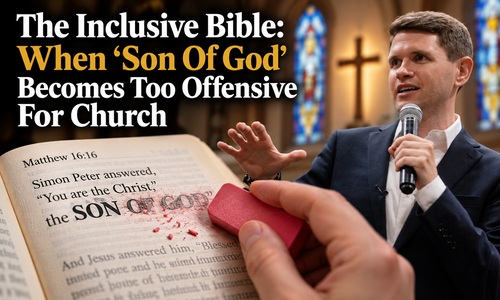
The Inclusive Bible describes itself as an egalitarian translation and a “re-imagining” of Scripture. Its translators did not merely replace generic masculine language where the underlying text permits it. They deliberately reconsidered biblical terminology they believed carried sexist, patriarchal or hierarchical implications.
That includes the language Christians use for God Himself.
“The Lord” presents a problem because the translators regard the expression as carrying “sexist and classist” associations. “Father” is frequently rendered with alternatives such as “Abba” or “Loving God.”
Even some of Christianity’s most recognizable descriptions of Jesus are considered difficult.
“Son of God” can become “Only Begotten,” “God’s Own” or “Eternally Begotten.” “Son of Man” receives alternative treatments as well. “Lord” is replaced in various places with terms such as “Sovereign” and “Savior.”
The issue isn’t simply modern English.
It is who gets to decide which biblical concepts modern people should no longer have to encounter.
var images = [],
index = 0;
images[0] = ““;
images[1] = ““;
images[2] = ““;
images[3] = ““;
index = Math.floor(Math.random() * images.length);
document.write(images[index]);
//done
Rigby himself offered a remarkable glimpse into that approach when an undercover journalist asked him about the translation. The pastor said the church typically gives people The Inclusive Bible when they join.
“It’s good on the gender stuff,” Rigby said.
He then acknowledged limitations with the translation before adding that having a good translation allows people to “let go of the stupid stuff.”
That phrase exposes the much deeper problem.
Who decides which parts are the “stupid stuff”?
For historic Christianity, Scripture is supposed to correct us. Increasingly, progressive Christianity appears determined to correct Scripture.
Once that relationship is reversed, there is virtually no stopping point.