

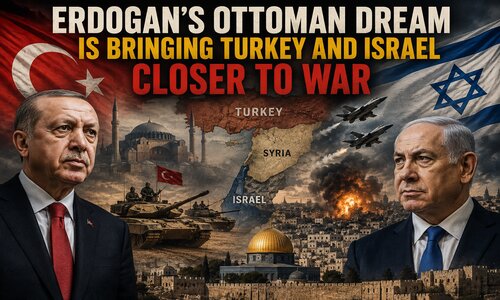
For years, Turkish President Recep Tayyip Erdogan’s declarations about Jerusalem could be dismissed as political theater–the inflammatory rhetoric of an Islamist leader seeking applause at home and influence across the Muslim world.
That explanation is becoming increasingly difficult to accept.
Turkey is no longer merely talking about restoring its influence across lands once controlled by the Ottoman Empire. The collapse of Bashar al-Assad’s government has given Ankara an extraordinary opportunity to expand its political and military presence in Syria, bringing Turkish power closer to Israel at precisely the same time Turkish leaders are becoming more explicit about their ambitions concerning Jerusalem.
Israel appears to have noticed the danger. And increasingly, it appears prepared to use military force to stop it.
What is developing in Syria could therefore become much bigger than another disagreement between two Middle Eastern governments. Two of the region’s strongest military powers are beginning to establish competing red lines in the same territory, while Erdogan’s neo-Ottoman vision provides an ideological backdrop that makes the confrontation even more troubling.
Syria Changes Everything
For decades, Israel’s primary concern in Syria was Iran.
Tehran used the Assad regime to move weapons, personnel and resources throughout the region, particularly to Hezbollah in Lebanon. Israel responded with an extensive campaign of airstrikes designed to prevent Iran from transforming Syria into another military front against the Jewish state.
But Assad is gone, Iran’s position has been dramatically weakened, and someone is moving into the vacuum.
Erdogan played an important role in supporting the forces that ultimately brought down Assad, and Ankara now enjoys considerable influence with Syria’s new Islamist leadership. Turkish forces already control significant territory in northern Syria, while Ankara has reportedly explored expanding its presence at Syrian military facilities previously associated with Assad’s Iranian and Russian allies.
For Israel, that presents an entirely new strategic problem.
Turkey is not Iran. It is a NATO member with one of the largest militaries in the region, a sophisticated defense industry, advanced aircraft, drones and missiles, and a geographic position that allows it to project significant power into Syria.
Israel spent years making certain Iran could not establish a permanent military infrastructure on its northern frontier. There is little reason to believe Jerusalem would suddenly accept Turkey doing something similar.
Recent events suggest it won’t.
var images = [],
index = 0;
images[0] = ““;
images[1] = ““;
images[2] = ““;
images[3] = ““;
index = Math.floor(Math.random() * images.length);
document.write(images[index]);
//done
Israel Draws A Red Line
On August 18, Israel carried out eight airstrikes against the Abu al-Duhur airbase near Idlib, targeting its runway and storage facilities.
What makes the attack particularly significant is what reportedly happened immediately beforehand.
A Turkish delegation had visited the facility and was apparently assessing whether the base could be used by Turkish forces. Hours later, Israeli aircraft struck it.
The message was difficult to miss.
Israeli Prime Minister Benjamin Netanyahu subsequently said the purpose of the attack was to prevent Turkish military forces from deploying there, arguing that Syria was approaching a breach of previously established security understandings.
Israel therefore appears to be establishing a very clear principle: Assad may be gone, but Syria will not simply become somebody else’s military platform against Israel.
For years that warning was directed primarily at Tehran.
Increasingly, it may be directed at Ankara.
That creates a potentially dangerous situation because neither Israel nor Turkey necessarily needs to desire a war for one eventually to occur. If Turkey continues expanding its military footprint while Israel continues attacking facilities intended to accommodate Turkish forces, eventually Israeli bombs could kill Turkish personnel.
At that point, a confrontation between Israel and Turkey would become considerably more difficult to contain.
Erdogan’s Ottoman Dream
This military competition cannot be separated entirely from Erdogan’s larger vision for Turkey.
Erdogan has spent years cultivating nostalgia for the Ottoman Empire and presenting Turkey as a natural leader of the Muslim world. Under his leadership, Ankara has become increasingly assertive across territories that were once governed from Istanbul.
Syria fits perfectly into that worldview.
Erdogan has previously declared that “Jerusalem is ours,” while repeatedly portraying Turkey as a defender of the Palestinian cause and maintaining close relations with Hamas. His anti-Israel rhetoric has intensified dramatically during periods of conflict.
But perhaps even more revealing are recent statements from other Turkish officials.