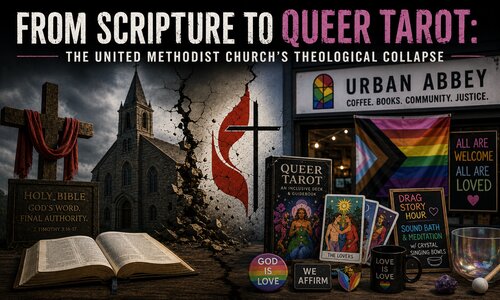


For years, conservative Christians have watched mainline denominations increasingly reinterpret Scripture through the lenses of modern sexuality, gender ideology, social justice and progressive politics. But another theological shift may be equally concerning, especially because it is beginning to appear in churches that still carry historically evangelical names.
Mysticism, interfaith spirituality, ancient paganism and speculative theories about the Bible are increasingly being blended into what is presented as Christian teaching. Instead of Scripture being the authority by which other spiritual claims are judged, outside philosophies and religious traditions are sometimes being used to reinterpret Scripture itself.
A striking example comes from Glendale Baptist Church in Nashville, Tennessee, where co-pastor Zach Helton recently presented his congregation with an extraordinary claim: the God of Israel once had a wife named Asherah, and later religious authorities essentially erased her from the biblical story.
Helton reportedly described Asherah as a “female divine presence” worshipped alongside Yahweh and argued that King Josiah’s destruction of Asherah poles and pagan shrines was less an act of spiritual reform than an attempt to consolidate religious and political power. He even lamented what Josiah’s reforms supposedly meant for young Israelite girls who, in Helton’s telling, were being deprived of a feminine divine figure to look up to.
There is one enormous problem with that interpretation: the Bible tells almost exactly the opposite story.
Asherah Wasn’t God’s Wife—She Was An Idol
Asherah certainly appears in the Bible, and ancient Israelites unquestionably worshipped her at various points in their history. But nowhere does Scripture identify her as Yahweh’s wife or present her worship as a legitimate expression of Israel’s faith.
Instead, worship of Asherah is repeatedly described as apostasy.
Judges 3:7 states that the children of Israel “did evil in the sight of the LORD” and “served Baalim and the groves [Asherahs].” Deuteronomy 16:21 specifically prohibits setting up an Asherah beside the altar of the Lord, while First Kings describes hundreds of prophets associated with Asherah being supported by the wicked Queen Jezebel.
Then comes King Josiah.
Second Kings 23 describes Josiah removing vessels made for Baal and Asherah from the Temple, destroying pagan shrines, removing idolatrous priests and tearing down the Asherah itself. Helton may view these actions through the modern categories of political power and gender, but the biblical author makes his own judgment unmistakably clear.
Rather than condemning Josiah, Scripture praises him.
Second Kings 23:25 declares that there was no king like Josiah who “turned to the LORD with all his heart, and with all his soul, and with all his might.” To transform that biblical hero into a villain therefore requires more than interpreting an ambiguous passage differently; it requires reversing the moral judgment that the biblical text itself explicitly provides.
var images = [],
index = 0;
images[0] = ““;
images[1] = ““;
images[2] = ““;
images[3] = ““;
index = Math.floor(Math.random() * images.length);
document.write(images[index]);
//done
Did Ancient Israelites Worship Yahweh And Asherah?
Here Helton touches on something real but draws a radically different conclusion from historic Christianity.
Archaeologists have uncovered ancient inscriptions that appear to associate Yahweh with “his asherah.” Scholars have debated precisely what those inscriptions mean, including whether they refer directly to the goddess Asherah or to a cultic object associated with her.
There is also abundant biblical evidence that Israelites mixed worship of Yahweh with pagan religion. But this is hardly a secret that later biblical writers successfully covered up—the Bible repeatedly and openly records it because Israel’s idolatry is one of the central themes of the Old Testament.