

For generations, America’s nuclear weapons were intended to prevent a world war. The growing danger is that they may now be viewed as the only way to avoid losing one.
The Pentagon is reportedly developing a revised nuclear strategy for a potential conflict with Russia or China. Overseen by Under Secretary of Defense for Policy Elbridge Colby, the review is said to place greater emphasis on shorter-range tactical nuclear weapons and provide the president with more options during a regional crisis.
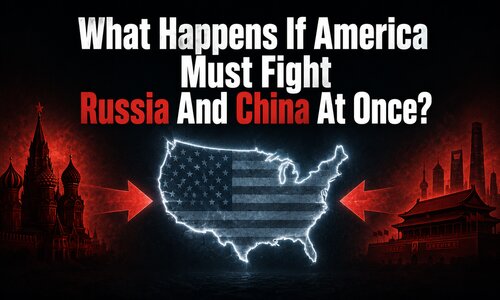
That does not mean Washington is planning to start a nuclear war. It means military officials are wrestling with a terrifying question: What happens if America becomes trapped in conflicts with Russia and China at the same time?
The answer may be forcing nuclear weapons closer to the battlefield.
America’s Two-Front Nightmare
For most of the Cold War, the United States concentrated its nuclear planning on one principal adversary: the Soviet Union. Today, Washington faces two nuclear powers capable of threatening the American homeland while waging major conventional wars in separate regions.
U.S. Strategic Command has publicly described this as an unprecedented challenge. Russia has nearly completed the modernization of its nuclear triad and continues to improve its tactical nuclear forces. China, meanwhile, is rapidly expanding an arsenal expected to become increasingly comparable to those of the United States and Russia.
The nightmare scenario is not difficult to imagine.
China could launch a blockade or invasion of Taiwan, drawing American aircraft, submarines, warships and long-range missiles into the Indo-Pacific. While Washington’s attention and military resources were concentrated there, Russia could increase pressure on NATO’s eastern flank–or exploit the crisis through cyberattacks, sabotage, missile deployments or a limited military incursion.
The sequence could also be reversed. America might become heavily committed to defending Europe while Beijing concludes that Washington is too distracted to stop a move against Taiwan.
Russia and China would not need to sign a formal agreement or launch perfectly coordinated invasions. Each would simply need to recognize the opportunity created by the other.
Conventional Strength Has Limits
America remains the world’s most powerful military, but it does not possess unlimited ships, aircraft, missiles, air-defense interceptors or trained personnel.
A major war in the Pacific would consume enormous quantities of precision-guided weapons. American and allied bases would face waves of ballistic and cruise missiles. Aircraft carriers, fuel depots, communications systems and satellites would all become targets.
At the same time, a European conflict would demand armored forces, air defenses, combat aircraft, logistical support and a continuous supply of ammunition.
The United States would be forced to divide its best capabilities across two distant theaters while still protecting the homeland, supporting allies in the Middle East and deterring North Korea.
That is where the nuclear danger becomes unavoidable.
When a nation fears that it may be overwhelmed conventionally, nuclear weapons become more attractive as an equalizer. Russia has long relied on its nuclear arsenal to compensate for areas of conventional weakness. America could now find itself confronting the same brutal calculation.
If U.S. forces were losing a critical battle, if an ally were facing defeat, or if America lacked enough conventional firepower to stop simultaneous offensives, the president could be presented with options that previously would have been considered unthinkable.
var images = [],
index = 0;
images[0] = ““;
images[1] = ““;
images[2] = ““;
images[3] = ““;
index = Math.floor(Math.random() * images.length);
document.write(images[index]);
//done
Why Tactical Nuclear Weapons Are Returning
The reported strategy appears intended to provide choices between conventional defeat and a massive strategic nuclear attack.