
For nearly two thousand years, these were sounds that belonged to the Bible.
The Temple was gone. The sacrifices had ceased. The priestly service ended. The silver trumpets associated with Israel’s ancient worship became artifacts of another age.
But on Rosh Hashanah this year, something remarkable happened on the Temple Mount.
Hundreds of Jews ascended the mountain. Organized Jewish prayer continued there for hours. Worshippers openly carried prayer books and wore traditional prayer shawls.
Then the shofar sounded.
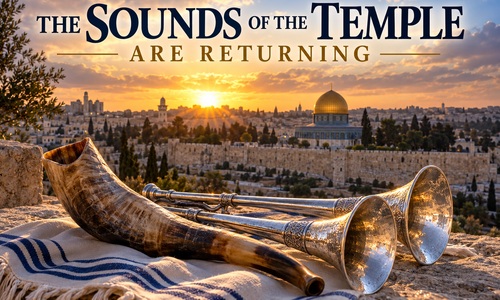
And beside it sounded two silver trumpets—recreating a combination of instruments associated with worship in ancient Jerusalem.
A Temple has not been rebuilt. Sacrifices have not resumed.
But increasingly, people are preparing as though they someday could.
Ancient Sounds Return To The Temple Mount
The significance of the silver trumpets could easily be missed.
God commanded Moses in Numbers 10 to make two trumpets of hammered silver. They became associated with Israel’s national life and worship, and Scripture specifically commanded their use during appointed festivals and over certain sacrifices.
For generations, Christians have read those passages as descriptions of Israel’s ancient past.
Now the sound of silver trumpets has been heard again on the mountain where the Temple once stood.
Rabbi Josh Wander, who participated in the Rosh Hashanah gathering, believes this was the first time in thousands of years that the shofar and silver trumpets had sounded together on the Temple Mount.
It was not completely permitted. Police briefly detained those responsible for bringing the instruments onto the Mount, and Israeli authorities confirmed that administrative proceedings were opened. But according to Wander, worshippers were allowed to finish each round of blasts before police intervened.
Three rounds were completed.
That might sound like a small detail. Against the recent history of the Temple Mount, however, it illustrates an extraordinary transformation.
For years, Jews could be removed or detained for visibly praying there. Even carrying Jewish prayer books was heavily restricted. This Rosh Hashanah, a large group spent hours openly praying, some wearing prayer shawls and carrying approved prayer books.
Practices once considered almost unimaginable are gradually becoming possible.
And Temple-related practices are beginning to appear with them.
var images = [],
index = 0;
images[0] = ““;
images[1] = ““;
images[2] = ““;
images[3] = ““;
index = Math.floor(Math.random() * images.length);
document.write(images[index]);
//done
They Aren’t Just Talking About A Temple
The trumpets are only one piece of a much larger story.
Jewish organizations dedicated to preparing for a future Temple have spent decades researching exactly how biblical Temple worship functioned.
Sacred vessels have been recreated. Priestly garments have been produced. The procedures surrounding sacrifices have been studied. Priests descended from the biblical priestly line have received instruction concerning Temple service.
These efforts are not about constructing a museum exhibit depicting ancient Judaism.
The stated objective of groups such as the Temple Institute is the eventual restoration of Temple worship.
That changes the significance of what is happening.
For centuries, Jews prayed for the restoration of Jerusalem and the Temple. Today, some Jews are moving beyond prayer and attempting to solve the practical problems that would arise if that opportunity ever came.
What vessels would be needed?
How would the priests serve?
How would sacrifices be performed?
How would biblical requirements concerning ritual purity be satisfied?
Increasingly, those questions are being treated not merely as matters of ancient history, but as preparations for a possible future.
Then There Are The Red Heifers
Perhaps nothing illustrates this shift better than the extraordinary attention surrounding the red heifer.
Numbers 19 describes a purification ceremony involving an unblemished red cow. Its ashes were mixed with water and used to cleanse people from ritual impurity associated with contact with the dead.
To most people, it is one of the more obscure commandments in the Old Testament.
To Jews preparing for renewed Temple worship, it is anything but obscure.