
Christianity and Islam disagree about some of the most fundamental questions imaginable. Who is Jesus Christ? Is He God incarnate? Did He die on the cross? Did He rise from the dead? Is salvation found through Him alone?
Yet inside the modern progressive religious movement, those enormous theological divisions can suddenly seem remarkably unimportant.
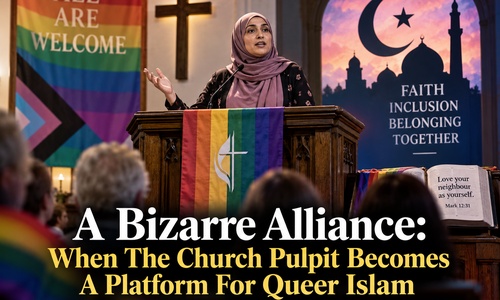
That strange convergence was on display at McDougall United Church in Calgary, where a Pride worship service featured Tahira Ebrahim, a Muslim speaker discussing the perspectives of queer Muslims and the attempt to reconcile LGBTQ identities with Islamic faith.
It was an extraordinary scene: a Christian sanctuary, a Muslim perspective and LGBTQ-affirming theology brought together under the banner of inclusion.
And perhaps that combination tells us something important about what is happening to parts of Western Christianity.
When Inclusion Becomes The Unifying Doctrine
McDougall makes no secret of its direction. The congregation identifies itself as an “Affirming” ministry and says it seeks inclusion regardless of sexual orientation, gender identity, gender expression, religious background and other differences. The church says it moved beyond merely being “welcoming” toward becoming an explicitly inclusive community.
Its Pride activities are similarly extensive. In September, McDougall hosted a joint Pride worship service with other United Church congregations. Days earlier, it hosted Calgary’s Citywide Pride Interfaith Service, an annual gathering intended to bring together affirming religious communities and LGBTQ organizations.
And that is where the story becomes much bigger than one speaker or one Canadian congregation.
Christianity and Islam cannot both be correct about Jesus.
Historic Christianity declares Him the divine Son of God, crucified and resurrected, the only way to the Father. Islam rejects several of those foundational Christian claims.
Those aren’t minor denominational disagreements.
Yet progressive religion has discovered something capable of bringing adherents of dramatically different faith traditions together: a shared understanding of identity, sexuality and inclusion.
var images = [],
index = 0;
images[0] = ““;
images[1] = ““;
images[2] = ““;
images[3] = ““;
index = Math.floor(Math.random() * images.length);
document.write(images[index]);
//done
A New Kind Of Interfaith Unity
For generations, interfaith gatherings generally focused on coexistence, religious liberty, community relationships or humanitarian causes. Christians could treat Muslims with dignity and friendship without pretending their theological differences didn’t exist.
Something different is increasingly taking shape.
The objective isn’t merely living peacefully beside someone who believes differently. Religious traditions themselves are increasingly being reinterpreted around a common progressive moral framework.
Christianity must become LGBTQ-affirming.
Islam must become LGBTQ-affirming.
Judaism must become LGBTQ-affirming.
And once that framework becomes the standard by which religion itself is judged, an extraordinary reversal occurs. Instead of Scripture defining which cultural ideas Christians accept, cultural ideas increasingly determine which interpretations of Scripture are considered acceptable.
The religions remain different, but the moral authority sitting above them begins to look remarkably similar.
What Exactly Is The Christian Pulpit For?
That raises an uncomfortable question churches eventually have to answer.
What is the pulpit actually for?