

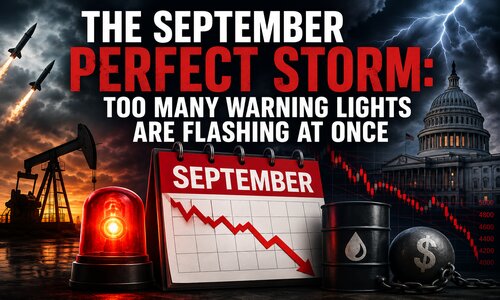
September has barely begun, and already the warning lights are flashing. War is escalating in the Middle East, oil prices are surging, diesel costs are soaring, and government bond yields are reaching levels not seen in decades. At the same time, America is carrying approximately $40 trillion in federal debt, the war in Ukraine continues to strain Europe, and investors are increasingly questioning whether the artificial intelligence boom has created another enormous financial bubble.
Any one of these developments would deserve attention, but the real concern is that they are happening at the same time. September already has an infamous reputation on Wall Street, historically ranking as the weakest month of the year for the S&P 500. That certainly doesn’t mean September 2026 will produce a crash; history doesn’t operate according to a calendar. But this September is arriving with an unusually combustible collection of risks already in place.
War Meets Wall Street
The most immediate danger is the rapidly escalating confrontation between the United States and Iran. On September 1, U.S. forces launched renewed strikes against Iranian targets following attacks against commercial shipping and American forces in the region, and Iran responded with missiles and drones directed toward U.S. positions.
The Strait of Hormuz remains at the center of the confrontation, making this much more than another regional military exchange. A substantial portion of the world’s petroleum supply normally moves through this narrow waterway, so any prolonged disruption immediately raises questions about global energy supplies.
Markets are already reacting. Oil futures jumped sharply Tuesday as the conflict intensified, while diesel prices have risen dramatically. But the consequences don’t stop at the gas pump. Diesel powers trucks, tractors, construction equipment and much of the machinery responsible for moving goods throughout the economy. Higher transportation costs eventually find their way into groceries, manufactured goods and countless other products, meaning another energy shock could push inflation higher just as central banks hoped they were finally bringing it under control.
The Bond Market Is Sending A Warning
Perhaps the most important development, however, isn’t occurring in the stock market. It is happening in bonds, where government borrowing costs are rising rapidly across much of the developed world.
Japan’s benchmark 10-year government bond yield has reached 3 percent for the first time since 1996. Britain’s 10-year government bond yield has climbed above 5.2 percent, reaching levels last seen around the time of the 2008 global financial crisis, while Germany’s benchmark yield has reached a 15-year high. Meanwhile, U.S. Treasury yields have also pushed toward levels that would have seemed extraordinary during the era of near-zero interest rates.
These numbers may sound abstract, but they eventually affect almost everyone because government bond yields influence mortgage rates, corporate borrowing, business expansion, auto loans and countless other forms of credit. The stock market gets most of the headlines, but the bond market may ultimately matter far more.
var images = [],
index = 0;
images[0] = ““;
images[1] = ““;
images[2] = ““;
images[3] = ““;
index = Math.floor(Math.random() * images.length);
document.write(images[index]);
//done
America’s $40 Trillion Problem
That becomes particularly concerning when combined with another historic development: the United States is now carrying approximately $40 trillion in federal debt.
Enormous government debt is much easier to manage when interest rates are extremely low. It becomes considerably more difficult when borrowing costs remain elevated because, as older government debt matures, Washington must continually refinance portions of it at prevailing rates.
That potentially creates a dangerous cycle. More debt requires more Treasury issuance, investors may demand higher yields to absorb that debt, and those higher yields increase government interest expenses. Higher interest expenses then increase deficits, requiring still more borrowing.
For years, politicians from both parties have been able to postpone dealing seriously with America’s fiscal trajectory. The bond market may eventually make postponement much more expensive.
AI Is Adding Another Layer Of Risk
Then there is artificial intelligence. AI may ultimately transform the global economy in extraordinary ways, but revolutionary technologies can still produce enormous financial bubbles. Railroads transformed America, yet railroad speculation repeatedly produced financial crises. The Internet transformed civilization, yet investors still lost trillions of dollars when the dot-com bubble collapsed.