
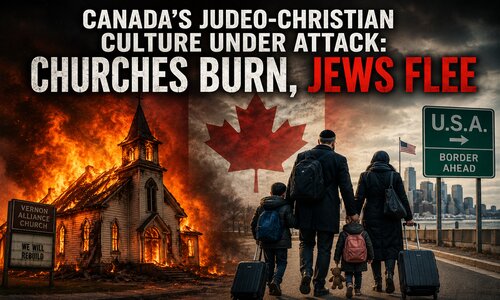
Another Canadian church has gone up in flames.
On Monday evening, fire tore through Vernon Alliance Church in Vernon, British Columbia, causing significant damage and bringing roughly 35 firefighters from several departments to the scene.
As of Tuesday, investigators had not determined the cause of the fire but the sight of yet another Canadian church engulfed in flames is difficult to ignore because it comes against a much larger and deeply troubling backdrop.
Just a week earlier, the historic Saint-Simon Catholic Church in New Brunswick was destroyed by fire. Built more than a century ago and long considered a landmark of the local Acadian community, the wooden church was reduced to ruins. In that case, authorities determined that the fire had been deliberately set, and 68-year-old Gilles Mallet was charged with arson.
Police have not said the Saint-Simon attack was religiously motivated. Nevertheless, it becomes another entry in Canada’s disturbing recent history of churches being burned or vandalized.
Since 2021, dozens upon dozens of Canadian churches have been damaged or destroyed, with some investigations putting the combined number of arson and vandalism incidents well above 100. The Macdonald-Laurier Institute reported in 2025 that arson targeting houses of worship had doubled following the controversy surrounding Canada’s residential schools and that more than 96 percent of the crimes examined remained unsolved.
Now an independent forensic investigation has been launched into the broader wave of attacks against churches and synagogues.
Not Every Fire Is Persecution
Accuracy matters here.
Not every burning church was deliberately targeted because it was Christian. Some fires remain unexplained, some incidents involve vandalism rather than arson, and motives differ from case to case. The cause of the Vernon Alliance Church fire remains unknown, while authorities have specifically said they have no evidence at this point that the Saint-Simon arson was religiously motivated.
But acknowledging those distinctions should not require Canadians to ignore the larger pattern.
Imagine if more than 100 buildings associated with virtually any other identifiable minority community had been burned or vandalized within a few years. Would the country simply shrug its shoulders?
Conservative leader Pierre Poilievre recently argued that attacks against Christians have received far less attention than they deserve, insisting that Canadians of every religion should be able to worship without fear.
That shouldn’t be controversial.
But Canada’s Christians aren’t the only religious community asking uncomfortable questions about what has happened to their country.
Jewish Canadians Are Looking For The Exit
At the same time churches are being vandalized and burned, Canada is confronting an extraordinary surge of antisemitism.
Since the October 7 Hamas massacre, Jewish schools, synagogues, businesses and families across Canada have faced bomb threats, vandalism, intimidation and violence. According to recent reporting, B’nai Brith Canada recorded 27 violent antisemitic incidents during just the first half of 2026–nearly three times the number recorded during all of 2025.
The situation has become serious enough that American Christian lawmakers and religious leaders are asking President Donald Trump to help Jewish Canadians leave.
The National Association of Christian Lawmakers and its partners recently appealed to the Trump administration to establish a lawful expedited pathway for Jewish Canadians who can demonstrate persecution or a credible fear for their safety. More than 2,000 Jewish Canadians have reportedly expressed interest in relocating because of security concerns.
Trump amplified the proposal on social media, although his administration has not announced an immigration program or formally committed to implementing one.
Think about what that means.
We are not talking about Jewish families attempting to escape Iran, Yemen or some openly antisemitic dictatorship. We are talking about Jews considering leaving Canada for the United States because they increasingly question whether their children, synagogues and communities are safe.