

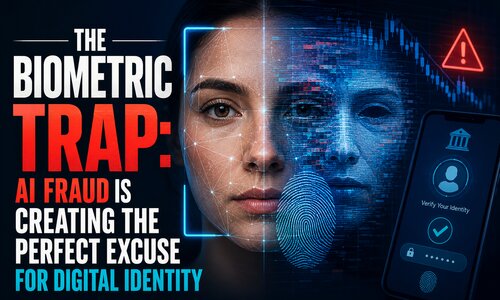
Artificial intelligence is rapidly changing the meaning of a simple question: How do you prove that you are really you?
For decades, passwords, identification cards, security questions and PIN numbers were considered sufficient for most transactions. But AI is beginning to undermine that entire system.
Faces can be generated. Voices can be cloned. Documents can be fabricated. Video calls can be manipulated with deepfakes. Synthetic identities can be created at enormous scale.
And governments and financial institutions are responding with a solution that could fundamentally change the relationship between individuals and the digital world:
Your body may become your identity credential.
Mexico has just provided a glimpse of where this could be headed.
The country’s banking regulator has expanded biometric requirements for financial institutions, requiring facial biometrics alongside existing fingerprint verification and giving banks just 90 days to implement liveness detection designed to distinguish an actual person from photographs, videos or artificial replicas.
The reason is understandable.
AI-powered identity fraud is becoming increasingly sophisticated, forcing banks to determine not merely whether someone possesses the correct credentials, but whether an actual human being is physically present behind them.
This is not simply Mexico’s problem.
Financial institutions around the world are increasingly confronting deepfakes, synthetic identities and cross-platform attacks, driving interest in continuous and networked biometric verification.
And that creates an uncomfortable paradox.
AI may create the very crisis necessary to make widespread biometric identity politically acceptable.
When Passwords Are No Longer Enough
Consider where the technology is leading.
A criminal attempting to access your bank account once needed your password.
Today he may be able to imitate your voice.
Tomorrow he may reproduce your face during a video verification process.
Soon an artificial intelligence system may be capable of constructing an entire convincing digital identity around stolen personal information.
The predictable response will be stronger verification.
Government-backed digital credentials.
And perhaps eventually continuous authentication proving that the person interacting with a system is still the authorized individual.
Even NIST’s current digital identity guidelines caution that biometric characteristics do not function like traditional secrets. They recommend that biometrics be used as part of multi-factor authentication, require alternative non-biometric options and classify biometric information as sensitive personal data.
There is a very important reason for that caution.
You can change a stolen password. You cannot change your face.
var images = [],
index = 0;
images[0] = ““;
images[1] = ““;
images[2] = ““;
images[3] = ““;
index = Math.floor(Math.random() * images.length);
document.write(images[index]);
//done
From Banking To The Internet
The larger issue is what happens when biometric identity moves beyond the bank.
Online age verification is already expanding, while biometric age estimation, device-based verification and privacy-preserving identity technologies are increasingly converging with digital services.
The progression is easy to imagine.
Prove your identity to access your money.
Prove your age to access certain websites.
Prove you are a human being before creating an account.
Verify who you are before participating in significant parts of the digital economy.
That final step is not yet reality, nor is it inevitable.
But the technological infrastructure required to make it possible is clearly developing.
And every major AI fraud incident will provide another powerful argument for expanding it.
Convenience Can Become Control
There is nothing inherently sinister about using Face ID to unlock a phone or fingerprints to protect a bank account.
The danger appears when previously separate systems become interconnected.