

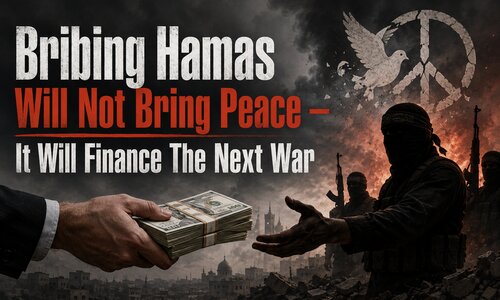
A recent report that US President Donald J. Trump’s Board of Peace is considering paying Palestinian terrorists in the Gaza Strip thousands of dollars in exchange for surrendering their rifles should alarm anyone who genuinely seeks peace and security in the Middle East.
If true, the proposal represents a dangerous retreat from the original objective of Trump’s September 2025 peace plan: the complete demilitarization of the Gaza Strip and the unconditional disarmament of Hamas and other terrorist groups.
Instead of insisting that Hamas dismantle its terrorist infrastructure without conditions, international mediators now appear to be discussing a plan to pay terrorists to hand over some of their weapons and enroll them in “rehabilitation” programs.
According to KAN, Israel’s Public Broadcasting Corporation, the internationally funded program would offer thousands of dollars to Gaza residents, including Hamas members, for each surrendered firearm, particularly Kalashnikov assault rifles. Participants would also be required to renounce violence and undergo future monitoring.
The proposal rests on two assumptions, both of which are dangerously flawed. The first is that Islamist terrorists can be persuaded to abandon jihad (holy war) in exchange for money. The second is that those who surrender weapons will genuinely renounce terrorism.
Hamas itself has already demonstrated why both assumptions are false. The answer came directly from the group’s slain leader, Ismail Haniyeh.
In 2020, Haniyeh publicly revealed that his group had rejected an offer worth $15 billion in development projects for the Gaza Strip. The package reportedly included an airport, a seaport, industrial zones, massive economic projects, and the lifting of restrictions imposed by Israel and Egypt. The only condition was that Hamas dismantle its military infrastructure, surrender its weapons, and integrate its fighters into civilian institutions.
Haniyeh proudly admitted that Hamas rejected the offer.
“We want a port in Gaza,” he said, “but as a right and not in exchange for our political principles or disarmament.”
He explained that Hamas had been asked to “dissolve our military factions… retire our weaponry… and dissolve the capability of Gaza for self-rule.”
Haniyeh’s response was unequivocal. “Our principle is Palestine from the [Jordan] River to the [Mediterranean] Sea,” he declared, making clear that Hamas preferred its jihad against Israel over airports, economic development, and billions of dollars in international investment.
var images = [],
index = 0;
images[0] = ““;
images[1] = ““;
images[2] = ““;
images[3] = ““;
index = Math.floor(Math.random() * images.length);
document.write(images[index]);
//done
If Hamas rejected $15 billion before its October 7, 2023 massacre in Israel because it refused to abandon terrorism, why would anyone believe that paying individual Hamas members a few thousand dollars today would produce a different outcome? It will not.
For years, Hamas supporters have argued that violence resulted from poverty, unemployment, and the Israeli blockade of the Gaza Strip. Haniyeh himself demolished that argument. His own words showed that the Gaza Strip had opportunities for unprecedented economic development that would have turned it into the Singapore of the Middle East.
The obstacle was never Israel. The obstacle was Hamas. The terrorist group consciously chose war over prosperity. It preferred rockets to an airport and seaport, tunnels instead of factories, assault rifles instead of jobs, and jihad instead of economic development. Hamas rejected all these projects because it refused to abandon its ideological commitment to destroying Israel.