

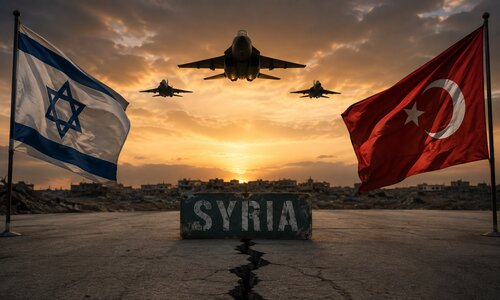
For years, Israel’s greatest concern in Syria was Iran.
Iranian forces, weapons depots, missile infrastructure and supply routes to Hezbollah gradually transformed Syria into a potential forward operating base against the Jewish state. Israel responded with hundreds of airstrikes designed to prevent that military infrastructure from becoming permanently entrenched.
But Syria has changed.
Iran’s influence has been dramatically weakened following the fall of Bashar al-Assad. Yet the power vacuum has not remained empty.
Turkey is moving in.
That is what makes Israel’s latest strike on Syria far more significant than another bombing raid.
Early Tuesday, Israeli aircraft struck the Abu al-Duhur military airbase in northwestern Syria, hitting the runway and storage facilities eight times, according to Syrian state media. No casualties were reported. Israel later acknowledged that the purpose of the attack was to prevent Turkish forces from deploying at the base.
The message to Ankara was difficult to miss:
Israel will not allow Syria to become a Turkish military platform on its northern frontier.
Turkey has become one of the principal foreign supporters of Syria’s government under President Ahmed al-Sharaa.
Ankara has been training Syrian forces, helping rebuild government institutions and infrastructure, and providing military and diplomatic support. Turkish officials have also been involved in efforts to rehabilitate Syria’s military capabilities.
That includes the Abu al-Duhur airbase.
The facility, roughly 70 kilometers from the Turkish border, has largely been out of service as a dedicated military airfield since 2013. But reports indicate Turkey had begun helping rehabilitate the facility as Ankara expands its influence inside Syria.
Israel apparently decided not to wait and see what came next.
According to the Israeli prime minister’s office, Syria was on the verge of violating what Israel described as an understanding to maintain the existing security situation by permitting Turkish troops to deploy at the airfield.
Israel did not bomb a fully operational Turkish military installation.
It bombed the infrastructure before Turkey could establish one.
Israel’s New Red Line
That reflects an increasingly important principle in Israeli security thinking: dangerous military capabilities are far easier to stop before they become operational.
October 7 demonstrated the potential price of allowing hostile forces to build military infrastructure while relying upon deterrence to contain their intentions.
Israel appears increasingly unwilling to make that gamble.
A runway can be repaired.
An airbase can be rebuilt.
But once Turkish aircraft, troops, radar systems or sophisticated air-defense systems are stationed there, striking the facility becomes dramatically more dangerous.
It possesses NATO’s second-largest military and remains a member of the Western alliance. A direct Israeli attack on Turkish forces could therefore produce consequences far beyond Syria.
That is precisely why Israel may believe it must establish the boundaries now.
The deeper concern is not simply Turkish soldiers.
It is control of Syrian airspace.
Turkey has reportedly been involved in efforts to rebuild Syrian air defenses, including radar infrastructure. Israeli officials fear that an expanded Turkish air-defense presence could eventually restrict Israel’s ability to operate freely over Syria.
For Israel, freedom of action over Syria has been central to preventing weapons transfers, missile deployments and hostile military entrenchment.
Any foreign power capable of closing that airspace would fundamentally alter Israel’s security environment.
var images = [],
index = 0;
images[0] = ““;
images[1] = ““;
images[2] = ““;
images[3] = ““;
index = Math.floor(Math.random() * images.length);
document.write(images[index]);
//done