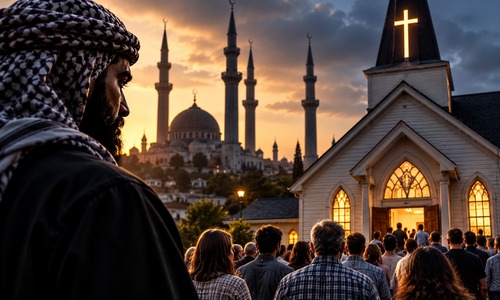

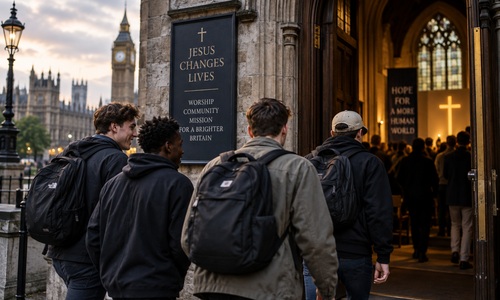
Britain has spent decades becoming one of the West’s great laboratories of secularization.
Church attendance declined. Christian identification fell. Historic churches struggled to fill their pews. Younger generations were widely assumed to be moving steadily away from organized religion altogether.
But something increasingly difficult to ignore is happening beneath that familiar story.
A major new study of evangelical Christianity in the United Kingdom has uncovered a remarkably different demographic picture — one that is younger, more diverse and, perhaps most surprisingly, predominantly male.
Young men aren’t simply hanging on to the Christianity of their grandparents. They are emerging as one of the most striking components of British evangelicalism.
The Evangelical Alliance’s new “Understanding UK Evangelicals” study surveyed 8,407 UK adults, including 3,804 people who identified as Christian.
Among those the researchers classified as “classic evangelicals” — Christians who strongly affirm evangelical beliefs, identify as evangelical and belong to Protestant traditions — 43 percent are under the age of 35.
Nearly one in five are between 18 and 24.
Another 24.1 percent are between 25 and 34.
And then comes perhaps the biggest surprise.
Some 61.6 percent of classic evangelicals are men.
Among the broader evangelical category, the number is nearly identical: 59.8 percent are male.
That turns the conventional image of modern Christianity on its head.
For years, churches across the Western world have worried about losing men, particularly young men. Christianity was increasingly portrayed as something disproportionately maintained by women and older generations while young males drifted toward secularism.
Yet Britain’s evangelical churches are producing a very different picture.
The demographic supposedly walking away may be helping drive what comes next.
And the numbers extend well beyond a small collection of unusually successful churches.
Researchers estimate that approximately 5.5 million people in Britain both hold evangelical beliefs and identify as evangelical. Another, more tightly defined group of approximately 2.6 million qualifies as “classic evangelicals.”
Perhaps most significant of all, 64 percent of what the researchers define as “practicing Christians” — those attending church at least monthly while independently praying and reading Scripture at least weekly — fall into the study’s broad evangelical category.
In other words, where active Christianity remains strongest, evangelical conviction occupies a remarkably large share of it.
var images = [],
index = 0;
images[0] = ““;
images[1] = ““;
images[2] = ““;
images[3] = ““;
index = Math.floor(Math.random() * images.length);
document.write(images[index]);
//done
There is another development that challenges stereotypes about Christianity’s future.
Nearly 30 percent of evangelicals come from ethnic minority backgrounds, compared with approximately 17 percent of the wider UK adult population. Among classic evangelicals, more than a quarter are black.
Pentecostals make up the largest denominational segment of classic evangelicals at 29 percent, while Anglicans account for another 17 percent.
This isn’t simply elderly congregations preserving the religious habits of another Britain.
Something younger is taking shape.
The study can tell us who these Christians are. It cannot definitively tell us why younger people — and especially men — are disproportionately represented.
But the nature of evangelical Christianity itself offers an intriguing contrast with the culture surrounding them.