
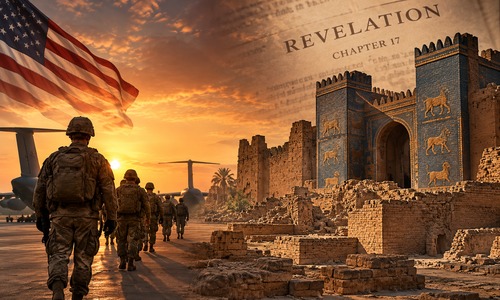
After more than two decades of American military involvement, the final U.S. forces have departed Iraq.
The withdrawal closes another remarkable chapter that began with the overthrow of Saddam Hussein in 2003, continued through America’s first withdrawal in 2011, and reopened when ISIS conquered huge portions of Iraq and Syria and forced American troops back into the country in 2014.
There are plenty of reasons to wonder what happens next.
Iran and its allies have celebrated the American departure as a strategic victory. Iran-backed militias remain powerful inside Iraq, while ISIS has never completely disappeared. Iraqi security forces must now shoulder greater responsibility without the permanent American military presence that once stood behind them.
But for students of Bible prophecy, Iraq raises an entirely different question.
About 50 miles south of Baghdad lie the ruins of Babylon.
This was the capital of Nebuchadnezzar. It was the empire that conquered Jerusalem, destroyed Solomon’s Temple and carried the Jewish people into captivity.
Yet Babylon doesn’t disappear when the Old Testament ends.
It returns dramatically in Revelation 17 and 18.
And that raises one of the most fascinating questions in Bible prophecy:
Is Babylon destined to rise again?
Babylon: A City Or A System?
Christians have debated that question for generations, including conservative dispensational prophecy scholars who agree on much of the end-times framework but don’t necessarily agree on every detail concerning Babylon.
John F. Walvoord, the longtime president of Dallas Theological Seminary and one of the most influential dispensational theologians of the 20th century, distinguished between the two Babylon’s depicted in Revelation.
He viewed Revelation 17 primarily as religious or ecclesiastical Babylon–a vast apostate religious system associated with the final world order.
Revelation 18, however, describes something different: an astonishing political and commercial power whose influence reaches kings, merchants and nations across the earth.
And here Walvoord entertained a remarkable possibility.
Could that Babylon actually be Babylon?
Walvoord noted that Isaiah 13 and Jeremiah 50-51 describe Babylon suffering a sudden and devastating destruction. Yet historical Babylon declined over a long period. It wasn’t suddenly obliterated when the Babylonian Empire fell.
Walvoord therefore concluded that, in several respects, a rebuilt Babylon provides the simpler literal fulfillment of those Old Testament prophecies and Revelation 18. He also allowed for the possibility of Rome functioning as an ecclesiastical center while rebuilt Babylon becomes the political and commercial capital.
That interpretation has been taken even further by contemporary prophecy scholar Mark Hitchcock.
Hitchcock argues that Babylon began as both a literal city and a center of organized rebellion against God. From Babel onward, Babylon represents mankind attempting to build civilization apart from its Creator.
But Hitchcock doesn’t believe that symbolism eliminates geography.
He believes Revelation ultimately takes us back to the place where the story began: literal Babylon in modern Iraq.
Under that interpretation, Revelation 17 describes a final religious system centered there, while Revelation 18 reveals Babylon as the political and economic center of Antichrist’s world system.
In other words, Babylon could be both a city and a system.
var images = [],
index = 0;
images[0] = ““;
images[1] = ““;
images[2] = ““;
images[3] = ““;
index = Math.floor(Math.random() * images.length);
document.write(images[index]);
//done
Could Babylon Really Be Rebuilt?
At the moment, ancient Babylon looks nothing like Revelation 18.
UNESCO describes the location about 85 kilometers south of Baghdad as an archaeological site containing ancient walls, gates, palaces and temples. Approximately 85 percent of the property remains unexcavated.
Saddam Hussein famously tried to resurrect some of Babylon’s former grandeur. Beginning in the 1980s, his government reconstructed portions of the ancient city, sometimes placing modern bricks directly over ancient foundations and stamping them with Saddam’s name.
His ambitions were unmistakable. The slogan of the 1987 Babylon International Festival reportedly proclaimed a renaissance stretching “from Nebuchadnezzar II to Saddam Hussein.”
But Saddam’s reconstructed Babylon was nothing remotely resembling Revelation’s global commercial powerhouse.
If Hitchcock and others are correct, that transformation remains future.
Babylon As A Global System
There is another possibility that shouldn’t be dismissed.
Babylon may primarily describe the culmination of the worldwide system that began at Babel.
Look at Revelation 17-18.
Religion is involved.
Political power is involved.
International commerce is involved.
Merchants become extraordinarily wealthy through it.
The nations participate in it.
And when Babylon suddenly collapses, economic powers around the world mourn.
That sounds much larger than one archaeological site in Iraq.
But these interpretations don’t necessarily contradict each other.