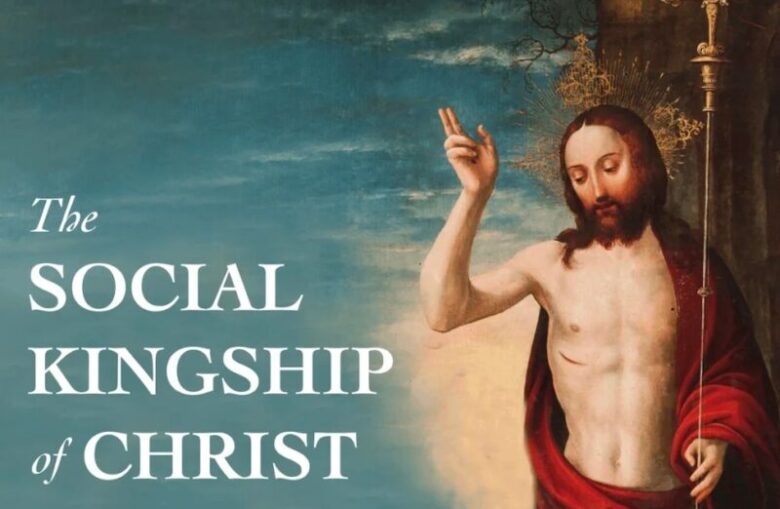
Stabat Mater Press has released a new translation of Fr. Théotime de Saint-Just’s *The Social Kingship of Christ According to Cardinal Pie*, bringing back into English a work centered on one of the most contested Catholic questions of the modern age: whether Christ’s authority applies only to private souls, or also to nations, laws, rulers, and public institutions.
The new edition, available in hardback and paperback, was highlighted in an Aug. 15 LifeSiteNews essay by a writer who said he contributed the foreword and receives no commission or benefit from sales.
At the center of the book is Cardinal Louis-Edouard-Désiré Pie, the 19th-century French bishop of Poitiers whose teaching on Christ’s social reign has long been influential among traditional Catholics, even as he remains little known to many English-speaking readers.
## Who Was Cardinal Pie?
Cardinal Pie was born in Pontgouin, France, in 1815. He became bishop of Poitiers in 1849 and was elevated to the College of Cardinals by Pope Leo XIII in 1879, about a year before his death in 1880.
According to the LifeSiteNews essay, Pie was admired by several popes. Pope St. Pius X is cited as having publicly praised him and called him “my master.”
For advocates of the doctrine known as the Social Kingship of Christ, Pie is not merely a historical figure. He is treated as one of the clearest Catholic voices arguing that Christ’s authority is not confined to personal devotion, but has claims on civil society itself.
That argument is precisely what Fr. Théotime’s book sets out to organize.
## The Question at the Heart of the Book
Fr. Théotime, a Capuchin priest, built his work as a synthesis of Cardinal Pie’s writings, sermons, and addresses. Rather than offering a loose anthology, the book arranges Pie’s teaching into a systematic treatment of the doctrine.
The LifeSiteNews essay identifies the central question from Fr. Théotime’s introduction:
> “Our Lord Jesus Christ – did He come to earth to sanctify souls, or did He also come to impose His will upon social institutions, codes of law, assemblies, and sovereigns themselves, thus becoming the supreme King of nations and peoples?”
Cardinal Pie’s answer, as presented in the book, is that Christ’s kingship necessarily extends beyond individual sanctification. If Christ is king over persons, the argument goes, then He remains king when those persons act together as families, societies, and nations.
That claim places the book directly in conflict with a common modern assumption: that religion may shape private belief, but should not claim authority over political order.
## Why This Translation Lands at a Volatile Moment
The LifeSiteNews author argues that the new translation is especially timely because the phrase “Christ is King” is now often used as a slogan while, in his view, being separated from its full doctrinal meaning.
The book’s defenders say Cardinal Pie’s teaching asks harder questions than a slogan can answer. What do states owe to God? Does Christ have rights over civil law and public institutions? What happens when societies formally reject the Faith?
Those were 19th-century questions in Pie’s France. Traditional Catholics argue they remain urgent today.
## How Fr. Théotime Organized Pie’s Teaching
According to the source essay, Fr. Théotime’s work proceeds in a deliberate order.
First, it lays out Cardinal Pie’s doctrine of Christ’s social reign and its consequences for nations and societies.
Then it turns to what Pie described as rebellion against that reign and the results of that rebellion.
The book also examines how Christ’s kingship might be restored, including the duties of different classes of people.
Finally, it presents Pie’s reflections on two possible futures for mankind: one in which Christ is permitted to reign, and another in which humanity repeats the Gospel cry, “We will not have this man to reign over us.”
The LifeSiteNews essay describes the work as a unified presentation drawing on Scripture, the Church Fathers, and the magisterium.
## Early Praise for the Work
Fr. Théotime’s book received strong praise in its own time, according to the material cited in the new edition and summarized by LifeSiteNews.
Fr. Josephus Antonius a Persiceto, Master General of the Order of Friars Minor Capuchin, reportedly wrote of the “greatest satisfaction” he had in reading the “fine work.”
Cardinal Mercier described it as “an illuminating synthesis.” A professor at the Catholic University of Paris praised Fr. Théotime for putting Cardinal Pie’s work “into scholastic form” and giving it “its full effectiveness against contemporary error.”
Fr. Adhémar d’Alès, S.J., writing in *Études* in 1924, said Fr. Théotime had gathered Pie’s teachings so “they might be heard by the present generation.” He summarized the work as presenting Christ’s right to reign over societies, the fact of general apostasy, means for restoration, and the future promised to that reign.
Other publications cited in the source, including *La France franciscaine*, *Nouvelle revue théologique*, *Revue des lectures*, and *Polybiblion*, also praised the work’s doctrine, clarity, and usefulness.
## The Vatican II Flashpoint
The new edition’s foreword, according to its author, places Fr. Théotime’s work in the context of contemporary debates over religious liberty and the Second Vatican Council.
The LifeSiteNews writer argues that Vatican II’s teaching on religious liberty is central to what he sees as a transformation of the older doctrine of Christ’s kingship. He says his foreword discusses how Vatican authorities have interpreted that teaching, as well as practical consequences he connects to issues ranging from COVID-19 to the 1988 episcopal consecrations of the Society of St. Pius X.
Those claims reflect a traditionalist critique and remain disputed within Catholic theology. Many Catholic theologians and Church authorities have argued that Vatican II’s religious liberty teaching can be understood in continuity with prior doctrine, while critics have maintained that the tension is more serious.
## A Hopeful or Dark Prophecy?
The book also considers whether Christians can reasonably hope for a restoration of Christ’s social reign before the end of the world.
According to the LifeSiteNews essay, Fr. Théotime was neither triumphalist nor despairing. He did not appear to expect a long period of social renewal before the end, but he did hold out hope for what he called a possible “brilliant autumn for Christian society at the end of the world.”
The source also quotes Cardinal Pie asking whether society must “descend a slippery slope to the bottom of the abyss” or “climb back up to the light.” Pie said the “predictions of the saints” and “premonitions of the good” seemed to allow hope for at least temporary days of triumph for the Church militant.
At the same time, Pie warned that as the world nears its end, faith would become increasingly difficult to find in public institutions and believers would scarcely dare to make a public profession of belief.
For the LifeSiteNews author, that warning feels especially relevant to present circumstances.
## Stabat Mater Press and Its Mission
Stabat Mater Press was founded in 2024 as a publisher of traditional Catholic books. According to the source, the press describes itself as “dedicated to the restoration and preservation of the Church’s intellectual and spiritual patrimony.”
The publisher says it prioritizes works related to, or illuminating, the Social Kingship of Christ.
The LifeSiteNews article contrasts Stabat Mater Press with some print-on-demand publishers that release low-quality OCR scans of older texts or mix Catholic works with occult, Masonic, heretical, or otherwise objectionable material. Stabat Mater Press, the article says, aims to avoid those problems by producing curated Catholic editions.
## Why the Book Matters to Its Supporters
For supporters of the new translation, the point is not simply historical interest. The book revives a doctrine they believe has been obscured, softened, or contradicted in modern Catholic life.
Cardinal Pie’s teaching, as presented by Fr. Théotime, insists that Christ’s kingship is public as well as private, social as well as personal, and political in its implications even when not reducible to party politics.
That is why the new edition is likely to interest traditional Catholics, Church historians, theologians, and readers trying to understand why the phrase “Christ is King” carries such weight in current debates.
Whether one agrees with Cardinal Pie’s conclusions or not, the new translation reintroduces a body of Catholic argument that refuses to let the question remain vague: If Christ is king, what does that require of nations?