

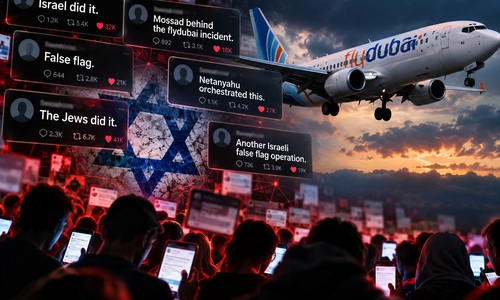
I went looking through social media after the flydubai incident with a fairly simple question: what really happened?
It didn’t take long before I discovered something almost as disturbing as the conspiracy theories themselves.
I looked at one post blaming Israel. Then another. Before long, the algorithms apparently figured out what had captured my attention. My feed began filling with accusations that Israel was behind the incident, that Mossad was involved, that it was a “false flag,” that the entire thing had somehow been staged.
And underneath those posts were thousands upon thousands of comments.
People weren’t simply asking questions. Many had already reached their conclusions. They were agreeing with one another, supplying additional theories and offering supposedly obvious reasons why the official story couldn’t possibly be true.
This was one person’s social-media feed after briefly exploring the subject.
Imagine that process multiplied across millions of phones.
It provides a disturbing glimpse into how conspiracy theories can explode across the internet today—and how an ancient habit of blaming Jews for the world’s problems has been given a distribution system unlike anything previous generations possessed.
The Mob Has Found Its Answer
The latest example came after the September 30 incident involving an Israel-bound flydubai aircraft.
Whatever investigators ultimately establish about precisely what happened, something remarkable was occurring online almost immediately.
According to the Combat Antisemitism Movement’s Antisemitism Research Center, researchers identified 2,963 posts on X during a 12-hour monitoring period that attributed the incident to Israel, Mossad, Israeli Prime Minister Benjamin Netanyahu, Zionists or Jews.
The first such accusation appeared just 67 minutes after the aircraft transmitted its initial distress signal.
Sixty-seven minutes.
International aviation incidents can require weeks, months and sometimes years of investigation. Authorities examine communications, flight data, cockpit recordings, security records, crew backgrounds and countless other pieces of evidence.
But portions of the internet apparently needed little more than an hour.
Researchers tracked 4,136 posts containing the phrase “false flag” and reported that approximately 72 percent promoted conspiracy claims blaming Israel or Jews. During the final two hourly monitoring periods, that proportion reportedly climbed above 80 percent.
Oliver Marks, a researcher with the organization, identified what may be the most important lesson from those numbers.
The narrative wasn’t necessarily being created because of evidence emerging from the flydubai incident. It looked more like a preexisting script waiting for another event to which it could be attached.
Evidence is supposed to produce conclusions.
Conspiracy culture increasingly begins with the conclusion and searches afterward for evidence.
var images = [],
index = 0;
images[0] = ““;
images[1] = ““;
images[2] = ““;
images[3] = ““;
index = Math.floor(Math.random() * images.length);
document.write(images[index]);
//done
An Old Conspiracy With A New Delivery System
There is nothing new about blaming Jews when catastrophe strikes.
For centuries, Jews have been accused of causing plagues, manipulating economies, starting wars, controlling governments and secretly engineering social upheaval.
The subjects change. The underlying accusation survives.
Even the September 11 attacks eventually became incorporated into this universe of conspiracy theories. Claims that Israel, Mossad or Jews secretly orchestrated or knowingly permitted 9/11 have circulated for decades despite the absence of credible evidence supporting them.
Then came October 7.
Following the Hamas massacre in Israel, social media became flooded with claims questioning atrocities, accusing Israel of deliberately killing its own citizens or suggesting elements of the attack had somehow been allowed to happen for political purposes.
Again and again the same remarkable pattern emerges.
Jews can become the victims of an attack—and then somehow become responsible for the attack against themselves.
CyberWell, which monitors online antisemitism, describes this phenomenon as a form of conspiratorial “self-victimization”: Jews or Israelis are accused of orchestrating attacks against themselves in order to manipulate public opinion.
It creates a conspiracy theory that is almost impossible to disprove.
If Jews are attacked, they staged it.
If Israel responds, that supposedly proves why they staged it.
If authorities deny the allegation, they’re participating in the cover-up.
If investigators find no evidence, that demonstrates how sophisticated the Mossad must have been.
Every possible outcome becomes additional “evidence.”
Could Bots Be Helping?
There is another uncomfortable question that deserves examination.
How much of what we’re seeing online is actually organic?
Researchers have documented for years how automated accounts can amplify misinformation, political propaganda and low-credibility material online. Bots can rapidly repost material, push hashtags, manufacture apparent momentum and help place fringe claims in front of much larger audiences.
That does not mean the thousands of posts surrounding the flydubai incident were generated by bots. There is presently no basis for making that assumption.
But bots don’t have to invent a conspiracy theory to make it dangerous.
They merely have to amplify one.
A relatively small number of accounts can push an accusation. Real people encounter it. Some believe it. Others repost it. Influencers discover that the subject generates enormous engagement. Algorithms detect that people are stopping, clicking, commenting and arguing.
Soon the distinction between artificial amplification and genuine human belief becomes extraordinarily difficult for the average person to recognize.
And eventually humans do the work themselves.