

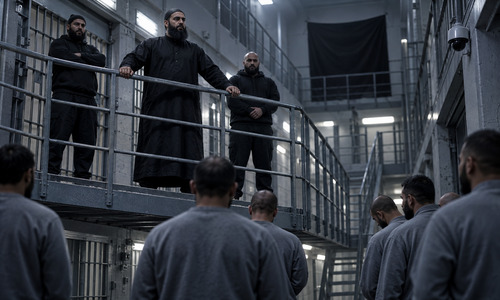
“Convert or get hurt.”
Three words. One terrifying choice.
For a vulnerable man entering the wrong British prison wing, those may be among the first words he hears. The message is not an invitation to examine a faith. It is an ultimatum from men who control protection, access, territory and punishment inside institutions the government is supposed to control.
Britain’s prisons have become incubators for a militant form of Islam that increasingly resembles organized gang rule. The leaders call themselves “emirs.” They surround themselves with enforcers, recruit frightened newcomers, impose religious rules and punish those who resist. What emerges behind the walls is something resembling a miniature caliphate—an alternative authority operating inside the British state.
This is not speculation from an anonymous former prisoner. It is contained in official government reviews.
Jonathan Hall KC, Britain’s independent reviewer of terrorism legislation, found that Islamist prisoners were exerting “controlling and radicalising influence” over other inmates. His report described recruitment through food, gifts and protection, followed by conversions backed by “implicit or actual violence.” Some groups attempted to segregate wings, control kitchens and showers, intimidate staff and operate unofficial Sharia courts where punishments reportedly included flogging.
A separate government review by Colin Bloom recorded numerous accounts from prison staff of the phrase “convert or get hurt.”
The State Surrendered The Wings
How could this happen inside government-controlled prisons?
Part of the answer is fear. Prison officials were reportedly reluctant to confront Islamist behavior because they did not want to be accused of discriminating against Muslims. Forced conversions could be dismissed as ordinary bullying. Unofficial religious gatherings could be treated as harmless expressions of faith. Even more astonishingly, Hall was told that some officers appealed to a wing “emir” to help maintain order.
That may create temporary calm, but it comes at a devastating price. The prison no longer controls the wing. The gang does.
Islamist power offers inmates a compelling package: protection from enemies, membership in a brotherhood, a new identity and a cause larger than themselves. For men who are lonely, angry, frightened or facing years behind bars, that offer can be enormously attractive. Once inside the group, however, belonging may require obedience—to the emir, to the gang’s rules and eventually to its ideology.
Two notorious terrorists demonstrate where that path can lead. Usman Khan spent years intimidating staff, attempting to convert prisoners and acting as an Islamist leader behind bars. After his release, he murdered Jack Merritt and Saskia Jones at Fishmongers’ Hall in 2019. Sudesh Amman also participated in efforts to convert inmates before being released and stabbing two people in Streatham in 2020.
Britain sent dangerous men into prison and allowed some of them to become more influential, more radical and more capable of recruiting others.
var images = [],
index = 0;
images[0] = ““;
images[1] = ““;
images[2] = ““;
images[3] = ““;
index = Math.floor(Math.random() * images.length);
document.write(images[index]);
//done