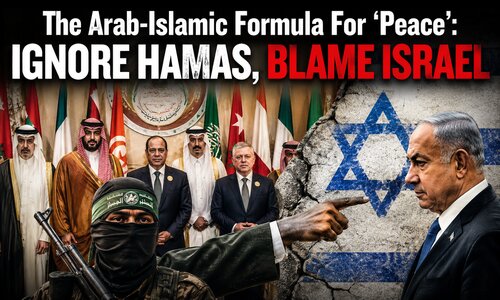


What if a peace agreement is not actually intended to produce peace?
That disturbing question is again confronting Israel after reports that one Arab country allegedly advised another to show flexibility toward Israel, reach an agreement, lower Israel’s defenses–and use the resulting calm to strengthen itself for a future confrontation.
Some reports have suggested the countries involved were Saudi Arabia and Syria, although that has not officially confirmed.
But the alleged strategy itself should sound painfully familiar to Israelis.
Because one of the most dangerous lessons of October 7 was that quiet does not necessarily mean peace.
Sometimes quiet is when your enemy is preparing.
The Lesson Of Hudaybiyyah
Israeli Arab affairs journalist Tzvi Yehezkeli has reportedly compared this mentality to one of the most famous episodes in early Islamic history: the Treaty of Hudaybiyyah.
In 628, Muhammad entered into a ten-year truce with the Quraysh tribe of Mecca.
This period of peace proved enormously advantageous to Muhammad’s movement. His political and military position grew substantially stronger. Two years later, after an allied tribe of the Quraysh attacked an allied tribe of Muhammad–an event regarded as violating the agreement–Muhammad used that pretext to march on Mecca with a dramatically larger force and conquered the city.
Hudaybiyyah illustrates something strategically important:
A truce can transform the balance of power.
An adversary who cannot achieve his objectives today may accept peace today while never abandoning those objectives tomorrow.
And Israel has encountered that thinking before.
Arafat Actually Invoked Hudaybiyyah
Perhaps the most chilling example came from Yasser Arafat himself.
Just months after the Oslo Accords transformed the Israeli-Palestinian relationship, Arafat addressed Muslims in Johannesburg, South Africa, on May 10, 1994.
He explicitly compared the agreement he had reached with Israel to Muhammad’s Hudaybiyyah agreement with the Quraysh. Contemporary documentation of the speech confirms the comparison.
Think about the implications.
Israelis were being encouraged to believe they had entered a new historical era.
Peace conferences were held. Handshakes were celebrated. Palestinian institutions were established. Israeli territory and security responsibilities were transferred in the expectation that political accommodation would gradually replace conflict.
Yet Arafat was simultaneously speaking to a Muslim audience using the historical analogy of a temporary truce made during an unfinished struggle.
Arafat’s audience heard Hudaybiyyah.
That should have produced far more uncomfortable questions than it did.
var images = [],
index = 0;
images[0] = ““;
images[1] = ““;
images[2] = ““;
images[3] = ““;
index = Math.floor(Math.random() * images.length);
document.write(images[index]);
//done
Hamas Perfected The Strategy Of Quiet
For years Israel fought Hamas, reached ceasefires, restored calm and repeated the cycle.
Each round produced the same hope: perhaps Hamas had finally been deterred.
But Hamas was digging.
Training terrorists.
Collecting intelligence.