
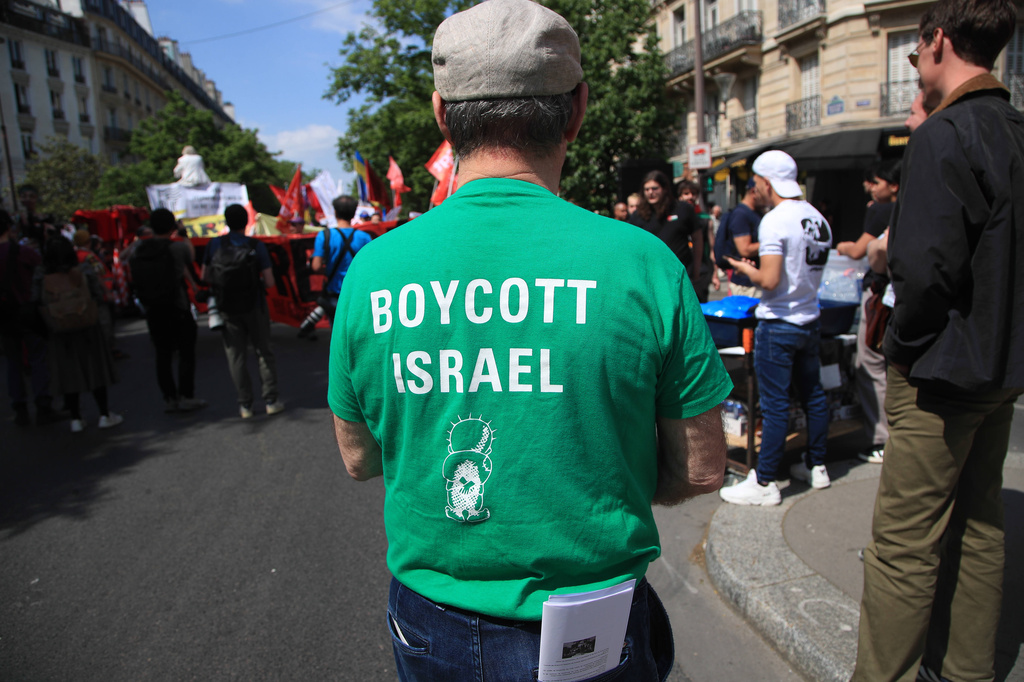
A CBN News report portrays the Boycott, Divestment and Sanctions (BDS) campaign broadening from campus activism to supermarket aisles and political vows—while also citing upbeat economic signals and new investment commitments tied to Israel’s tech sector.
Street boycotts and political vows
The report describes protesters in a U.K. ASDA supermarket removing Israeli products. One protester said, “Today, we went into this ASDA supermarket, and we took the Israeli goods and the Coca-Cola products from the shelves.”

According to the report, the campaign has increasingly taken an economic form, with “several countries” moving to restrict trade specifically with Israeli communities in Judea and Samaria.
In New York City, the report states that Zohran Mamdani—identified in the report as “Mayor”—said he will not continue the New York–Israel Economic Council created under what the report calls “former Mayor Eric Adams.” Mamdani publicly backs BDS. At one rally he said, “We want to let them know that there are three letters that we have as an answer to what is happening in Palestine: And it’s B-D-S!”
The report also features Abdul El‑Sayed—described there as the Democrats’ nominee for the U.S. Senate in Michigan—questioning U.S. financial support for Israel: “The question about whether Israel has a right to exist is actually quite secondary to whether or not they have a right to our tax dollars.”
Campus pipeline and an “information war”
Dr. Charles Asher Small, executive director of the Institute for the Study of Global Antisemitism and Policy, frames the campaign against Israel as part of a broader information battle. “The demonization of Jews, the demonization now of Israel, has a deep pedigree,” he told CBN News. He also claimed, “Qatar is a small country in the Middle East of only 300,000 people, and they give more money to American universities than any other country in the world,” arguing that influence on campuses can shape society.
Boardroom stakes: pullback—or more capital?
Venture capitalist Michael Fertik warned that pressure could extend to research ties and investment: “For reasons of political bent, propaganda, antisemitism, or otherwise, or just a mistake, there are people who want to put the brakes on anything to do with Israel. And that could be academic research or collaboration; that could be investment.”
He also argued that “among people who care about business first, the information war is being won by the people sympathetic to Israel, because the business case for Israel is inarguable.” Fertik said, “We at Verdict have been deploying Verdict Fund One, and we expect to deploy approximately 15 percent—15 percent of the fund—into Israeli startups,” calling it a ten‑fold increase in his financial commitment. “In spite of all the naysayers… Israel seems to go from strength to strength,” he added.
U.S. ties and jobs
Attorney Gabe Groisman, who works with Israeli companies entering the American market, highlighted knock‑on effects in the United States. He pointed to Israeli firms’ U.S. entities and hiring, saying their products and services “help improve American lives.”
Numbers cited on growth and markets
The report states that, even after years of war and disruption, the Bank of Israel is forecasting 4 percent growth this year and 5.5 percent in 2027.
It also identifies Mike Huckabee as the U.S. Ambassador to Israel and quotes him describing resilience on the ground: “The GDP has grown in Israel in the midst of wars. The stock market, since October the 7th, is up 100 percent.” He added that Jerusalem’s skyline features “300 cranes,” which he cast as a sign of continued building.
What the report portrays
Overall, the CBN News report presents a widening boycott push—from consumer actions to political pledges—set against continued investment bets and growth projections for Israel’s economy.