

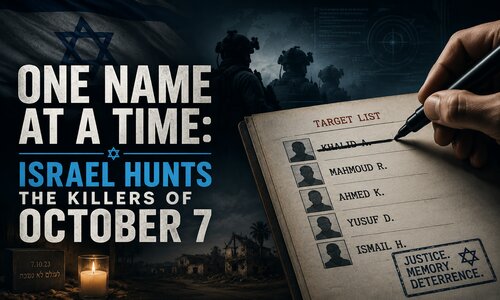
It contains the names and identities of the terrorists believed to have participated in the October 7 massacre–the men who crossed into Israeli communities, murdered civilians, kidnapped families and helped drag hostages back into Gaza.
And Israel has made clear that the passage of time will not make those names disappear.
Israeli security services have now publicly acknowledged a special mission dedicated to identifying and pursuing those involved in the attack. The unit, known as NILI, has reportedly built an enormous target database using intelligence gathered from captured terrorists, released hostages, surveillance footage, facial recognition technology and even videos recorded by the attackers themselves.
Israeli officials say thousands of those on the list have already been killed, either during the October 7 fighting or in subsequent military operations, while hundreds more have been captured.
One Israeli soldier reportedly described the operation in chillingly simple terms: the names are kept in a computerized list, and as individuals are eliminated, another line disappears.
But Israel has been here before.
The Shadow Of Munich
In September 1972, Palestinian terrorists from Black September attacked Israeli athletes at the Munich Olympics. Eleven members of the Israeli Olympic team were ultimately murdered.
Israel’s response did not end when the television cameras left Munich.
Over the following years, Israeli intelligence pursued individuals believed to have been connected to the massacre and the terrorist networks behind it. The campaign became one of the most famous examples of targeted counterterrorism in modern history.
The message was unmistakable:
You may escape the scene of the crime, but that does not mean you have escaped accountability.
That same philosophy appears to be shaping Israel’s response to October 7.
Ceasefires may come and go. Governments may change. Diplomatic pressure may increase. But Israel appears determined that participation in the worst massacre of Jews since the Holocaust will not simply be absorbed into another Middle Eastern political settlement.
There will be consequences.
Critics will inevitably describe such a campaign as revenge.
But there is an important distinction.
Revenge seeks suffering because suffering has occurred.
Justice seeks accountability for those responsible.
October 7 was not an anonymous act of war carried out by faceless armies. Many of the perpetrators recorded themselves entering Israeli communities. Cameras captured kidnappings, shootings and assaults. Intelligence agencies have spent years identifying the individuals involved.
Israel is not merely saying, “Someone attacked us.”
It is asking, “Who did it?”
That distinction matters.
Nations have an obligation not only to defend their citizens during an attack, but also to ensure that those who deliberately murder civilians do not simply disappear back into society and wait for the next opportunity.
For Israel, allowing October 7 terrorists to receive effective amnesty could send exactly the wrong message.
var images = [],
index = 0;
images[0] = ““;
images[1] = ““;
images[2] = ““;
images[3] = ““;
index = Math.floor(Math.random() * images.length);
document.write(images[index]);
//done
Deterrence Is About The Next Terrorist
The real audience for Israel’s campaign is not only the people whose names are already on the list.
It is the people considering joining the next massacre.
Deterrence depends upon creating consequences that an enemy believes are real.
If a terrorist thinks he can cross into Israel, murder civilians, return home, survive long enough for international pressure to produce a ceasefire and then live safely under a political agreement, the deterrent effect is weak.