
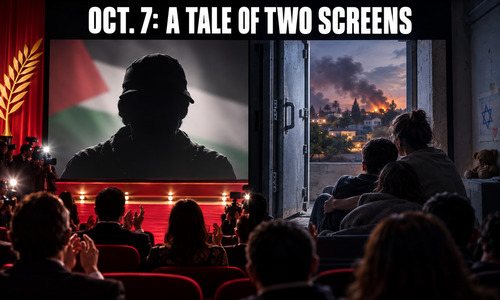
As the third anniversary of the October 7 massacre approaches, two Israeli-made productions are offering the world sharply different accounts of the war that followed. One is “Naza,” a documentary that premiered at the Venice Film Festival this month to a standing ovation lasting nearly 25 minutes, accusing the Israel Defense Forces of running a policy of mass civilian killing in Gaza. The other is the fifth season of “Fauda,” the Israeli television drama now streaming globally on Netflix, which devotes two full episodes to recreating the Hamas-led attack itself, built in part on real footage from that day, much of it filmed by the terrorists.
The two productions arrived within days of each other, and the contrasts are shocking. “Naza” rests on anonymous, unverifiable testimony that the Israeli military says is riddled with internal contradictions and claims beyond what its own subjects could have known. “Fauda,” despite being a work of fiction, hews so closely to the documented record of October 7 that one reviewer argued the season actually understates what happened that day.
“Naza” is an 80-minute documentary co-directed by Yuval Abraham and Rachel Szor, built on interviews conducted over three years with 24 Israeli soldiers and intelligence officers who say they were involved in Israel’s military campaign in Gaza. The interview subjects, whose identities are concealed, were filmed at night on rooftops in Tel Aviv, with their faces and voices digitally altered.
The film takes its title from a Hebrew military acronym meaning “collateral damage.” Its central claim is that the IDF used an artificial intelligence system called “Lavender,” which mines Gaza’s mass-surveilled telecommunications network for phone calls, movements and interactions, to identify targets for strikes in which civilian deaths were anticipated and accepted in advance rather than treated as unintended consequences. One interviewee claims approval was given for a strike on a single Hamas operative despite the possibility that as many as 500 civilians could be killed. Others describe the process in stark terms. “It’s like a video game because everything is done remotely,” one says. Another calls it “insanely fun.”
“Naza” received the Special Jury Prize at the 83rd Venice Film Festival on September 12 and a standing ovation lasting 23 to 25 minutes at its premiere two days earlier, with some audience members holding Palestinian flags. Tunisian director Kaouther Ben Hania, a member of the festival jury and director of last year’s Gaza-themed “The Voice of Hind Rajab,” praised the film at the post-awards press conference: “Those two brilliant directors found a way with the constraints of filming testimonies anonymously. And it’s not about their feelings. They are cogs in a bigger machine. I found this just brilliant, necessary, and very important in a time when we are talking a lot about denial.”
Accepting the award, Abraham said, “We believe that the denial of a crime is what helps it persist, and that’s why it’s important for us that the Israelis see this film.” He also credited Palestinian journalists with documenting events in Gaza before the filmmakers began their work, saying more than 200 of them have been killed by Israel.
“Naza” is produced by The Guardian and James Wilson, with “The Zone of Interest” director Jonathan Glazer serving as an executive producer.
The Difficulties and the Response
The Israel Defense Forces issued a formal rejection of the film’s central allegations the day after its premiere. “The IDF categorically rejects these allegations,” the Spokesperson’s statement read. It went on to note that the film relies on anonymous testimonies from individuals whose identities “cannot be verified, including whether they served in the IDF, in what capacity, or whether they were involved in the matters about which the allegations are being made.”
The statement said the excerpts cited “include claims regarding national and military strategy that are clearly beyond the knowledge of junior-level soldiers,” and pointed to what it called “internal and absurd contradictions,” including the claim that unintended harm from lawful strikes was somehow simultaneously deliberate and part of “genocide.” On the film’s central technical claim, the IDF was direct: decisions on the selection and approval of strikes “are made by human personnel only… and not by artificial intelligence.”
var images = [],
index = 0;
images[0] = ““;
images[1] = ““;
images[2] = ““;
images[3] = ““;
index = Math.floor(Math.random() * images.length);
document.write(images[index]);
//done
Former Prime Minister Naftali Bennett went further, calling the film a “blood libel” in a post on X the day after its premiere. “What makes it especially painful and infuriating is that this lie comes from Israeli filmmakers and is now being spread around the world,” Bennett wrote. “If Israel wanted to hurt the people of Gaza, we would not send our sons and daughters to fight house to house, through alleyways and tunnels, at the terrible cost of our own soldiers being killed and wounded. The war in Gaza is terrible. The death of every child is a tragedy. But a terrible war is not genocide.”
Culture Minister Miki Zohar announced he would move to revoke the directors’ Israeli citizenship, calling them “despicable creators” who are “willing to harm their homeland in order to receive applause from antisemites around the world” and accusing them of “an act of treason against the state.” National Security Minister Itamar Ben-Gvir called the pair “a disgrace and an embarrassment to the entire people of Israel” and told them, “I am certain that your friends, that is to say our enemies Hamas in Gaza, will welcome you with open arms.” As a legal matter, Zohar does not have the authority to revoke citizenship on his own; Israeli law allows it only in narrow circumstances involving treason or espionage, and any such action would require further government and legal proceedings.
Writing in JNS, Fiamma Nirenstein, a senior research fellow at the Jerusalem Center for Security and Foreign Affairs, drew directly on her own reporting from Gaza to challenge the film’s account. She described visiting IDF command tents at Tze’elim, where officers explained how strike decisions are issued in real time to protect both soldiers and civilians, and meeting the military lawyers who determine under international law whether a target is lawful. “Never in the history of warfare has an army done so much to try to protect the civilian population of its enemy,” she wrote, calling the anonymous accusations in “Naza” “one of the oldest weapons in the arsenal of antisemitism: a blood libel.”
The film is not the first collaboration between its directors to draw this kind of response. Abraham and Szor previously co-directed “No Other Land” (2024) with Palestinian filmmakers Basel Adra and Hamdan Ballal, a documentary on Israeli demolitions and displacement of Palestinian communities in Masafer Yatta, in Judea and Samaria. That film won the 2025 Academy Award for Best Documentary Feature after earlier wins at the Berlin Film Festival, the European Film Academy and the Gotham Awards, but drew the same charge now leveled at “Naza”: that it presents a one-sided account.
Critics writing in the Jewish Journal and for Creative Community for Peace argued the film “demonizes Israelis” by omitting the security rationale behind Israeli policy, noting that Israeli forces thwarted more than 1,000 terror attacks in Judea and Samaria in 2024 alone, and that it gave short shrift to the Hamas massacre of October 7. Zohar attacked that film as well at the time, calling its Oscar win “a sad moment for the world of cinema” and accusing it of “defamation” that “distorts Israel’s image.” Notably, “No Other Land” also drew fire from the opposite direction: the Palestinian Campaign for the Academic and Cultural Boycott of Israel opposed the film on “anti-normalization” grounds, objecting to Palestinian and Israeli filmmakers working together at all.
“Fauda,” created by Lior Raz and journalist Avi Issacharoff, follows an elite Israeli counterterrorism unit whose members disguise themselves as Palestinians to infiltrate terrorist networks. Its fifth season, an 11-episode run that premiered in Israel in the spring and arrived globally on Netflix on September 8, was rewritten entirely after October 7. The creators had already been developing a season built around a hostage-rescue plot when the massacre occurred. “That Saturday morning, we saw something way, way, way worse than what we tried to imagine then,” Issacharoff said. The rewrite took roughly a year.
The new season is set two years after the attack and follows Doron Kabilio, played by Raz, and his team as they race to stop a new Hamas plot originating in Marseille, France. Episodes seven and eight break from the present-day storyline to depict October 7 itself, recreating the Nova music festival massacre and a family trapped in their reinforced safe room as terrorists set the door on fire. The episodes are shot to resemble news footage, dashcam video, and material filmed by the attackers themselves. Israeli broadcaster Yes, which airs the series domestically, issued a formal viewer warning before the two episodes for the first time in the show’s history and made them free to watch across Israel in recognition of their significance.