
By the time you read this, Michigan voters may already have decided the Democratic nominee for the U.S. Senate.
But the outcome, important as it is, may not be the biggest story.
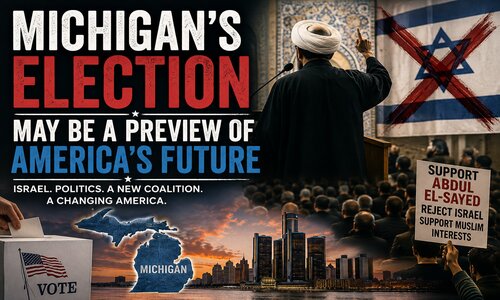
During the campaign’s closing days, a Michigan cleric declared from the pulpit that Muslims had a religious duty to support Abdul El-Sayed because his opponent supported Israel. It was a remarkable moment–not simply because a religious leader endorsed a candidate, but because support for Israel was presented as a disqualifying issue.
Whether El-Sayed ultimately wins or loses, the campaign has revealed something Christians should not ignore. Across parts of America, a new political coalition is emerging where Israel increasingly serves as the defining issue around which activists, religious leaders, and organized voting blocs are mobilizing.
Michigan may simply be the first state where that reality became impossible to ignore.
For decades, support for Israel was one of the few issues that enjoyed broad bipartisan consensus in Washington. Republicans and Democrats often disagreed over the details of Middle East policy, but America’s strategic partnership with Israel remained remarkably durable. That consensus is no longer guaranteed.
Today, Israel has become one of the most polarizing issues in American politics. Increasingly, candidates are being judged less by their positions on taxes, healthcare, or the economy than by where they stand on the Jewish state. The aftermath of October 7 accelerated this trend, exposing deep divisions inside political parties, universities, activist organizations, and even religious communities.
The Michigan Senate race illustrates how dramatically the conversation has shifted.
According to translated remarks reported by MEMRI, the cleric did not simply encourage civic participation. He framed voting for El-Sayed as a religious obligation because he was a fellow Muslim who would support Muslim interests, while portraying support for Israel as grounds for rejecting the opposing candidate. Regardless of how one views the election itself, the message reflected an unmistakable reality: Israel is increasingly becoming a political litmus test.
That raises questions extending far beyond a single campaign.
A New Political Coalition
One of the most significant developments in recent years has been the emergence of an increasingly organized coalition united by criticism of Israel.
This coalition is not monolithic. It includes progressive activists, some Muslim advocacy organizations, student protest movements, democratic socialist groups, and pro-Palestinian activist networks. These groups disagree on many domestic issues, yet opposition to Israeli policy has become a cause capable of bringing them together politically.
Their influence is becoming increasingly visible.
Candidates are facing pressure to call for restrictions on military aid, recognize a Palestinian state, distance themselves from Israel’s government, or adopt stronger criticism of Israeli military actions. Primary elections, once focused almost exclusively on local concerns, are increasingly becoming referendums on Middle East policy.
Whether one agrees with these positions or not, their growing political influence is difficult to dismiss.
var images = [],
index = 0;
images[0] = ““;
images[1] = ““;
images[2] = ““;
images[3] = ““;
index = Math.floor(Math.random() * images.length);
document.write(images[index]);
//done
Why Michigan Matters
Michigan occupies a unique place in American politics.