

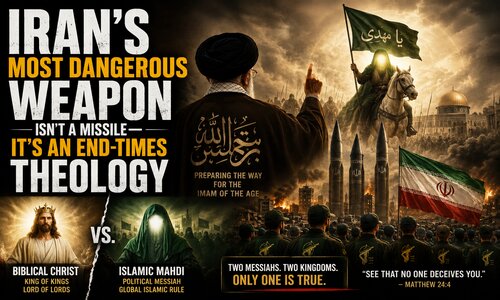
The West tends to explain wars in terms of military strength, economics, diplomacy, and political ambition. Those factors certainly matter. But when it comes to Iran, one critical element is often overlooked: theology.
For many in the Islamic Republic, history is not simply unfolding–it is moving toward a divinely ordained climax. The current conflict with the United States and Israel is viewed by some not merely as another Middle East war, but as part of the events that will usher in the return of Islam’s long-awaited messianic figure: the Mahdi.
That belief is no longer confined to obscure religious circles. It has become intertwined with the ideology of the Islamic Republic itself, echoed by senior officials, promoted within the Islamic Revolutionary Guard Corps (IRGC), and increasingly amplified across the Muslim world through social media.
This matters because beliefs shape behavior. Nations do not simply fight with weapons; they fight with worldviews. And when leaders become convinced they are participating in a divine script, traditional assumptions about deterrence, compromise, and even survival begin to change.
A Theology That Shapes A Nation
Iran is the world’s largest Shiite Islamic power, and its ruling establishment is deeply rooted in Twelver Shiite theology. Central to that belief is the expectation that the Twelfth Imam, Muhammad al-Mahdi, did not die but entered a state of hidden existence over a thousand years ago. One day, believers say, he will return to establish worldwide justice after a period of extraordinary chaos, bloodshed, and oppression.
Unlike many religious traditions where end-times prophecy remains largely academic, Mahdist expectation has become woven into the identity of Iran’s revolutionary government.
Since the 1979 Islamic Revolution, Iranian leaders have repeatedly framed their struggle against the West as part of a larger spiritual battle. References to martyrdom, sacrifice, and preparing the way for the Mahdi are common themes in official speeches and state ceremonies.
Recent reports suggesting that some within the Revolutionary Guard believe the current war could precede the Mahdi’s appearance should therefore surprise no one. Whether every specific claim proves accurate is secondary to the larger reality: the expectation itself is deeply embedded within the ideological framework of the regime.
Even senior representatives of Supreme Leader Ayatollah Ali Khamenei have described the Revolutionary Guard and its elite Quds Force as instruments for preparing the way for the “Imam of the Age.”
That is not fringe theology. It is part of the worldview of one of the most powerful military organizations in the Middle East.
var images = [],
index = 0;
images[0] = ““;
images[1] = ““;
images[2] = ““;
images[3] = ““;
index = Math.floor(Math.random() * images.length);
document.write(images[index]);
//done
When Prophecy Changes Military Strategy
Western military planners generally assume every government seeks self-preservation.
History suggests otherwise.
People convinced they are participating in God’s final plan often accept sacrifices that appear irrational to outside observers.
Throughout the Iran-Iraq War, hundreds of thousands of young Iranians willingly marched into overwhelming danger, inspired by themes of martyrdom rooted in the Battle of Karbala. The willingness to suffer for a perceived divine purpose became a defining feature of the Islamic Republic’s identity.
That same theology continues to influence how many believers understand the present conflict.
If hardship is interpreted as evidence that prophecy is unfolding, military setbacks do not necessarily weaken resolve–they can reinforce it.
If suffering is viewed as preparation for the Mahdi’s return, escalating conflict may be embraced rather than avoided.
That helps explain why Iran has repeatedly endured devastating sanctions, economic collapse, and military losses without abandoning many of its long-term objectives.
The calculus is not merely geopolitical.
The Mahdi And The Biblical Christ Could Not Be More Different
Many Christians know little about Islamic end-times beliefs. Yet understanding them has become increasingly important.
Islam teaches that the Mahdi will establish global Islamic rule. According to many Islamic traditions, Jesus (Isa) will also return–but not as Christianity understands Him.
Instead, Islamic tradition portrays Jesus as affirming Islam, rejecting His own divine identity, breaking the cross, abolishing Christianity as it exists today, and helping establish Islamic authority over the nations.
Some traditions even describe the conversion of Jews and Christians to Islam under this new order.